 sales@wildnetedge.com
 +1 (212) 901 8616
 +1 (437) 225-7733
















































































































 ChatGPT Development & Enablement
  Hire AI & ChatGPT Experts
  ChatGPT Apps by Industry
  ChatGPT Blog
  ChatGPT Case study
  AI Development Services
  Industry AI Solutions
  AI Consulting & Research
  Automation & Intelligence





TL;DR
Manufacturing in 2026 is nothing like it used to be. Factories are smarter, machines talk to each other, and software runs everything from inventory to quality checks. This guide walks you through the Best Manufacturing Software Development Companies in the USA, teams that can build real Industrial Automation systems, custom Production ERP platforms, and modern factory tech that actually fits the way your plant works.
Manufacturing today looks nothing like it did even a few years ago. Production lines are faster, machines are smarter, and leadership teams expect real-time visibility into everything happening on the floor. But behind the scenes, many factories are still juggling outdated systems, old machines that can’t “talk” to anything, and spreadsheets that get updated long after the shift ends. It slows everything down.
That’s exactly why the Best Manufacturing Software Development Companies matter so much right now. These teams don’t come in with generic tools. They understand the daily challenges inside a plant, the sudden machine stops, the supply delays that throw off your entire schedule, and the disconnect between what your ERP shows and what operators actually see on the line. They build software that fits your reality, not the other way around.This list will help you find partners who can help you move forward confidently.
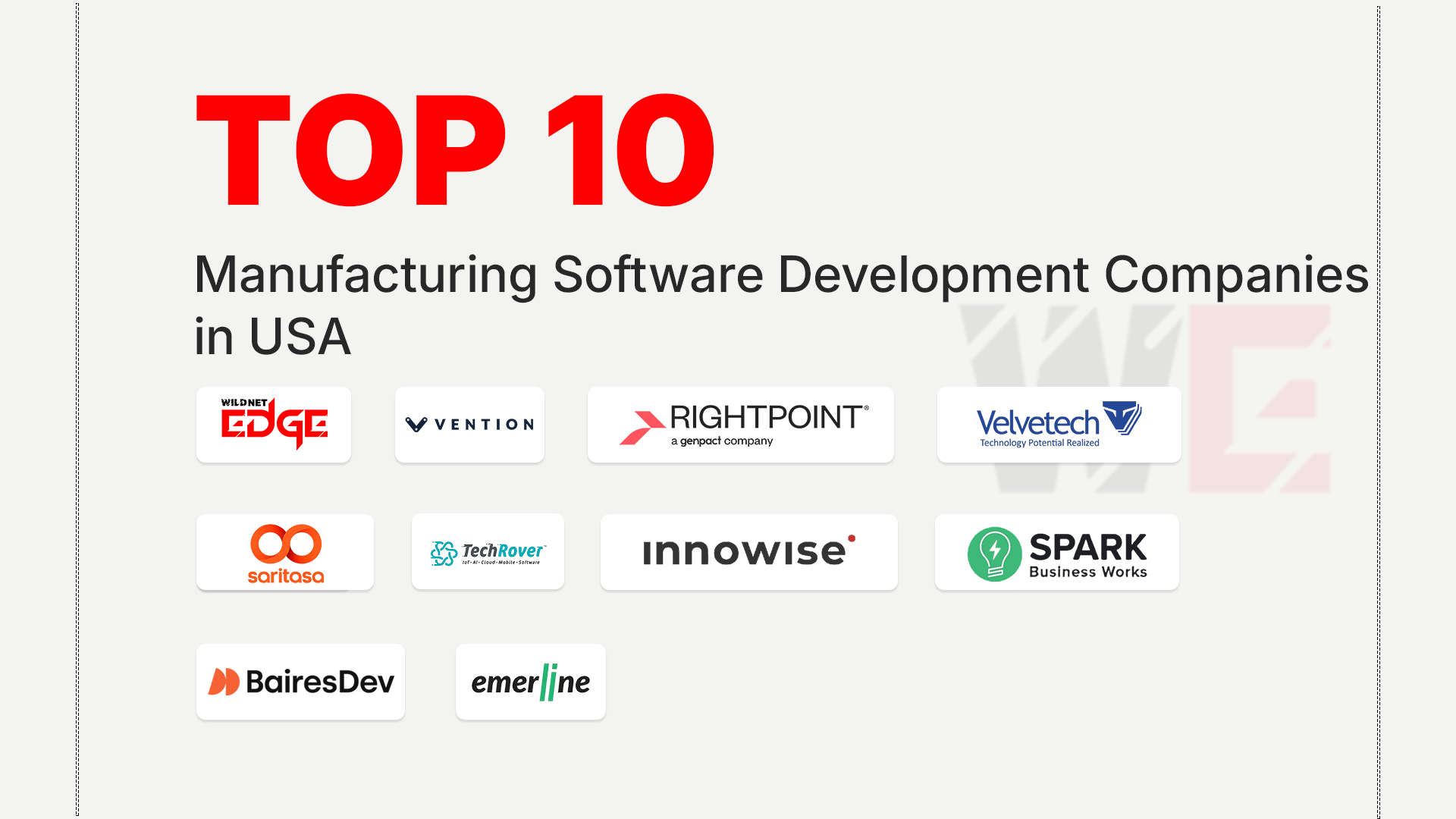
Comparative Matrix: Top 10 Manufacturing Software Development Companies
| Company | Core Services | Industries Served |
| Wildnet Edge | Enterprise Manufacturing, AI/IoT, Digital Twins | Manufacturing, Automotive, Energy, Logistics |
| Vention | Industrial Automation, Cloud Robotics, Design | Manufacturing, Automotive, Aerospace |
| Rightpoint | IIoT, Enterprise Software, Digital Transformation | Construction, Healthcare, Manufacturing |
| Velvetech | Custom Software, IoT, Embedded Systems | Manufacturing, Energy, Healthcare |
| Saritasa | Custom Software, IoT, Firmware, Mobile | Logistics, Manufacturing, Healthcare |
| TechRover | Manufacturing Software, Cloud, CMMI Level 5 | Manufacturing, Energy, Retail |
| Innowise Group | Custom Software, Staff Augmentation, ERP | Automotive, Manufacturing, Logistics |
| SPARK Business Works | Custom Software, Data Dashboards, Workflow | Manufacturing, Construction, Trades |
| BairesDev | Staff Augmentation, Custom Software, QA | Technology, Manufacturing, Logistics |
| Emerline | ERP Development, Cloud Migration, IoT | Manufacturing, Logistics, Retail |
Top 10 Manufacturing Software Development Companies in USA for 2026
1. Wildnet Edge
- Best for: Enterprise-scale, AI-driven smart factory ecosystems and digital twin implementation.
- Key highlights:
- Over 19 years of industry experience (Founded in 2005).
- Enterprise-scale team of 350+ certified engineers.
- Proven track record with 8,000+ projects delivered.
- CMMI Level 3 appraised for mature, repeatable processes.
Wildnet Edge stands out in this list because it understands manufacturing in a very practical way. They build systems that actually match how your machines, people, and workflows operate in real life. Their team works on everything, MES upgrades, predictive maintenance systems, connected IoT sensors, Production ERP, quality control automation, and even digital twin models. They’re one of the Best Manufacturing Software Development Company if your goal is a modern, connected factory.
What truly differentiates Wildnet Edge is its AI-first approach. They engineer intelligent industrial platforms. This includes integrating AI models for predictive maintenance (anticipating machine failure days in advance), creating digital twins to simulate production changes, and automating quality control using computer vision. Their solutions are designed to turn raw telemetry data into actionable operational savings and higher throughput.
Clients often say Wildnet Edge feels like having an “industrial brain” sitting next to them; the team understands why bottlenecks happen and what technology can realistically fix. They’ve worked with legacy machines, modern PLCs, and hybrid lines that mix old and new equipment. That experience shows in how they build solutions: everything is rugged, stable, and built to handle factory chaos.
Their engineers also bridge the gap between OT and IT teams, which is rare. If your floor supervisors speak in downtime numbers and your IT team speaks in APIs, Wildnet Edge knows how to make both sides understand each other. They’re not focused on shiny dashboards; they’re focused on making production smoother.
Projects Built (Highlights):
- AI-Powered Predictive Maintenance Suite: Architected a custom IIoT platform for a heavy equipment manufacturer. The system uses edge AI to analyze vibration and temperature data, predicting component failures with 95% accuracy and reducing unplanned downtime.
- Smart Factory Digital Twin: Developed a real-time 3D digital twin of a production line. This allows plant managers to simulate workflow changes and monitor efficiency metrics (OEE) remotely via a secure web portal.
- Automated Quality Control System: Built a computer vision solution integrated with conveyor belts. High-speed cameras detect defects in real-time, automatically rejecting faulty parts and updating the central ERP with quality reports.
- Pros:
- Enterprise-scale (350+ engineers) for handling complex, multi-site industrial rollouts.
- AI-first approach integrates edge computing and predictive maintenance models.
- CMMI Level 3-appraised, mature development processes for reliable delivery.
- Full-lifecycle partner for strategy, firmware consulting, app development, and support.
- Cons:
- Their comprehensive, enterprise-grade architecture is designed for complex industrial environments, which may be “over-engineering” for a simple inventory spreadsheet replacement.
- Their focus on deep custom engineering and data integration represents a strategic investment, not a low-cost option for basic off-the-shelf sensor setups.
2. Vention
- Best for: Industrial automation hardware design and cloud-based machine control.
- Key highlights:
- “MachineBuilder” platform for custom equipment design.
- Deep integration of hardware and software automation.
- Focus on democratizing industrial automation.
Vention offers something different. They combine physical machine-building with software, letting manufacturers design custom equipment online and automate it quickly. Their 3D cloud platform lets you design machines, order the parts, and program them, all in one workflow. That alone makes them one of the Best Manufacturing Software Development Companies for plants that need agility.
They’re great if your production changes frequently or if you rely on custom robots or assembly stations. Their tools help reduce engineering time, simplify automation, and get machines running without large integration teams.
Working with Vention feels less like hiring a software company and more like using a very clever toolbox. Their platform lets you design equipment visually, which makes collaboration between engineers, floor operators, and managers much easier. Instead of endless meetings, people can see the machine taking shape in the browser.
- Pros:
- Unique platform that combines hardware design with software control.
- Extremely fast deployment for custom industrial automation cells.
- Cons:
- Highly specialized focus on machine automation; less suited for general business ERPs.
- Requires investment in their hardware ecosystem for maximum benefit.
- Not a general-purpose custom software consultancy.
3. Rightpoint
- Best for: Industrial IoT interfaces and employee experience (EX) tools.
- Key highlights:
- Experience with robotics and industrial controls (e.g., Boston Dynamics).
- Strong focus on improving workforce productivity tools.
- Expertise in visualizing complex industrial data.
Rightpoint brings a unique “human-centric” approach to the manufacturing floor. They are one of the Best Manufacturing Software Development Companies for businesses that want to build software that their employees actually want to use. They excel at building intuitive interfaces for complex industrial machinery and IoT devices. Their work with companies like Boston Dynamics demonstrates their ability to translate complex engineering data into usable mobile and web controllers. They are the perfect partner for manufacturers looking to modernize their HMI (Human-Machine Interface) and internal workflows.
- Pros:
- Excellent at making complex industrial tools user-friendly.
- Strong capability in IoT and connected worker solutions.
- Cons:
- Less focused on pure ERP backend logic than traditional systems integrators.
- Premium pricing for design-led engineering.
- May be “overkill” for simple data logging applications.
4. Velvetech
- Best for: Custom industrial software with a focus on IoT and embedded systems.
- Key highlights:
- Specialized in Industrial IoT and embedded systems.
- Strong focus on M2M (Machine-to-Machine) communication.
- Expertise in data visualization and analytics.
Velvetech focuses on practical industrial software, especially IoT systems, connected devices, and embedded engineering. As one of the Best Manufacturing Software Development Companies, they help machines talk to each other and help humans understand what’s happening through dashboards or mobile apps.
If your goal is M2M automation (machines adjusting cycles automatically based on data), Velvetech is a solid pick. Velvetech feels like a team of engineers who enjoy solving tough, technical problems. They’re hands-on with hardware and understand the messy details of machine behavior, packet loss, sensor noise, connection drops, and performance bottlenecks.
Their software is built to withstand factory realities. It’s functional, direct, and designed to help teams make better decisions. They may not create the flashiest UI, but everything works reliably. If your main need is industrial functionality, they’re a dependable partner.
- Pros:
- Specific focus on industrial and M2M use cases.
- Strong US-based presence for close collaboration.
- Cons:
- May lack the high-end consumer UI/UX polish of digital agencies.
- Smaller team size than global systems integrators.
- Focus is more on functional utility than cutting-edge experimentation.
5. Saritasa
- Best for: Integrating custom hardware, firmware, and mobile apps for the factory floor.
- Key highlights:
- Deep expertise in IoT and custom hardware integration.
- Full-stack development capabilities (mobile, web, backend).
- 15+ years of industry experience.
Saritasa is ideal where digital tools touch physical devices, scanners, handheld tools, custom sensors, or mobile apps for technicians. They handle everything end-to-end: device firmware, backend, mobile apps, web dashboards.
Saritasa has a knack for simplifying complicated setups. If your factory uses custom devices or field tools, they make sure everything connects smoothly. They understand battery life issues, network coverage challenges, and the limitations of older machines.
Their solutions are practical and user-friendly. They focus on giving technicians and operators tools that make their day easier, not adding more complexity. If your team uses mobile devices heavily, Saritasa is a great fit.
- Pros:
- Unique expertise in IoT and hardware integration for industrial use cases.
- Versatile, full-stack development team.
- Cons:
- Manufacturing is one of many verticals, not an exclusive focus.
- May be over-qualified and more expensive for simple tracking apps.
- Their focus is on complex custom software, not just off-the-shelf configuration.
6. TechRover
- Best for: High-compliance manufacturing projects requiring CMMI Level 5 quality.
- Key highlights:
- CMMI Level 5 certified company.
- Strong focus on cloud computing, AI, and IoT.
- Integrity and accountability are core values.
TechRover is a CMMI Level 5 company, which means its development process is extremely disciplined. That makes them ideal for aerospace, medical manufacturing, and regulated industries. TechRover keeps things extremely structured. They run detailed reviews, document everything, and build systems that can’t fail easily. If you’re in an industry where one software bug can halt production or violate compliance, their rigor matters. They’re not the fastest because of this structure, but they’re dependable when precision matters more than speed.
- Pros:
- CMMI Level 5 certification guarantees elite process maturity and quality.
- Strong focus on high-stakes, mission-critical software.
- Cons:
- Their rigorous processes may be too slow for rapid prototyping needs.
- Smaller team size compared to global giants.
- Premium pricing reflects their high-level certification.
7. Innowise Group
- Best for: Large-scale backend integration and cost-effective development.
- Key highlights:
- Large, global team (3,000+ employees).
- Strong focus on staff augmentation and dedicated teams.
- Extensive experience in data engineering and API integration.
Innowise Group is great for companies that need large engineering teams without massive US-based pricing. They handle ERP builds, MES add-ons, data cleanup, and API integrations. Innowise is strong when you need many hands working on big, complex systems. If your ERP talks to ten different legacy tools and you need everything connected, they can provide a big team fast. They’re cost-effective and reliable, especially for long-term projects.
- Pros:
- Ability to scale teams and resources very quickly.
- Cost-effective model for long-term development and maintenance.
- Cons:
- Staff augmentation model means the client manages the strategic direction.
- Global team can lead to time-zone and communication challenges.
- Lacks the deep, niche consulting focus of a boutique industrial agency.
8. SPARK Business Works
- Best for: Custom workflow automation and data dashboards for mid-market manufacturers.
- Key highlights:
- Focuses on “business-first” custom software.
- Expertise in digital forms, dashboards, and workflow tools.
- US-based team in Michigan.
SPARK is great for practical, everyday manufacturing problems: replacing clipboards, digitizing forms, building production dashboards, and automating simple workflows. SPARK understands the reality of busy plant floors. They focus on tools that make daily work easier, not giant systems that take a year to implement. Think digital work orders, mobile forms, supervisor dashboards, and alerts. If your team still uses spreadsheets, email threads, or handwritten notes, SPARK can modernize everything without overwhelming your staff.
- Pros:
- Deep understanding of practical, day-to-day manufacturing workflows.
- User-friendly software designed for non-technical floor staff.
- Cons:
- May lack the deep AI/IoT engineering capabilities of larger tech firms.
- Focused on operational efficiency tools rather than massive ERP overhauls.
- Smaller team size limits capacity for huge enterprise projects.
9. BairesDev
- Best for: Rapidly scaling development teams with elite nearshore talent.
- Key highlights:
- Massive scale (4,000+ employees).
- Provides nearshore talent from Latin America.
- Claims to hire the “Top 1% of tech talent.”
BairesDev supplies large engineering teams fast, especially useful for companies that have internal leadership but need more developers. BairesDev works best when you have a roadmap but not enough hands to build everything. Their nearshore developers work in similar time zones, making collaboration smoother. They’re practical, consistent, and a good fit for long-term, ongoing development.
- Pros:
- Access to a large pool of elite, pre-vetted engineering talent.
- Cost-effective model for large-scale projects compared to US-only firms.
- Cons:
- Primarily a staff augmentation model; the client is responsible for project management.
- Lacks the cohesive, single-agency strategic direction of a full-service firm.
- Quality relies heavily on the specific developers assigned to the team.
10. Emerline
- Best for: ERP development and cloud migration for manufacturing.
- Key highlights:
- Strong expertise in ERP and IoT.
- ISO 27001 certified for information security.
- Experience with supply chain and logistics software.
Emerline specializes in building custom ERP features, migrating old systems to the cloud, and integrating IoT devices into operations. Emerline is thoughtful and detail-oriented. As one of the Best Manufacturing Software Development Companies, they take older systems and slowly rebuild them into modern platforms without disrupting production. They’re especially helpful if you want real-time data across the supply chain. They’re not the fastest, but they’re careful, which matters in manufacturing.
- Pros:
- Strong capability in building integrated ERP and IoT platforms.
- ISO certified for security and quality management.
- Cons:
- Some clients have reported delayed response times during projects.
- Projects can sometimes take longer than initially expected.
- Global delivery model requires effective cross-border collaboration.
Our Selection Criteria: How We Chose the Best Manufacturing Software Development Companies
Selecting the Best Manufacturing Software Development Companies in the USA for 2026 required a focus on deep domain expertise, industrial security, and technical excellence. We carefully evaluated each company using a set of key parameters.
Here’s what we looked at:
- Industrial Domain Expertise: We prioritized firms with verifiable experience in the manufacturing sector. This includes understanding shop floor operations, SCADA/PLC integration, and the specific needs of discrete vs. process manufacturing.
- Technical Capability: We looked for companies that excel at integrating complex third-party APIs for ERPs (SAP, Oracle), PLM systems, and industrial protocols (OPC UA, MQTT), which is the backbone of Industrial Automation.
- Innovation in AI & IoT: We evaluated their ability to leverage modern tech. We looked for firms building AI-powered predictive maintenance models, digital twins, and automated quality control systems.
- Proven Track Record: Experience matters. We considered each firm’s years in business, the complexity of their manufacturing projects, client portfolios, and verified success stories.
- Security & Compliance: We assessed their ability to build secure systems that comply with industrial standards like IEC 62443 and protect sensitive IP and operational data.
- Scalability: We assessed how each company handles enterprise-scale deployments and their ability to build systems that can scale with factory expansion.
- Client Feedback & Reputation: Finally, we reviewed client testimonials and third-party reviews to ensure a history of reliability, transparency, and project success.
You might also be interested in exploring the top software development companies—if you’re specifically looking for best web development firms, we have a dedicated guide for that too.
What Does Manufacturing Software Development Cost in 2026?
Manufacturing software development costs vary significantly based on complexity, integration requirements, and team location. Custom MES development for a mid-sized plant typically ranges from $50,000 to $250,000. A full production ERP with IoT integration can cost $150,000 to $500,000 or more. Predictive maintenance systems leveraging AI and sensor data range from $80,000 to $200,000 depending on the number of machines and data volume.
| Software Type | Estimated Cost (USD) | Timeline |
|---|---|---|
| Basic MES Module | $50,000–$100,000 | 3–4 months |
| Custom Production ERP | $150,000–$350,000 | 8–14 months |
| IoT Sensor Integration Platform | $80,000–$200,000 | 5–9 months |
| Predictive Maintenance System | $80,000–$180,000 | 4–8 months |
| Digital Twin Implementation | $120,000–$300,000 | 7–12 months |
| Full Smart Factory Platform | $300,000–$600,000+ | 12–24 months |
Conclusion
In 2026, manufacturing is digital, automated, and data-driven. The Best Manufacturing Software Development Companies listed above, including industry leaders like Wildnet Edge, provide the critical, specialized engineering expertise to build these complex systems. By selecting a top-tier partner, you are not just hiring developers; you are investing in a robust, efficient, and future-proof foundation for your industrial business.
FAQs
Manufacturing software development is the process of creating digital tools that manage and optimize production processes. This includes software for production planning, inventory control, quality assurance, equipment maintenance, and supply chain management.
Industrial Automation involves using control systems (like robots, computers, and IT) to handle different processes and machinery in an industry to replace human beings. In software terms, it means automating the flow of data and decisions between these machines to optimize production.
Production ERP (Enterprise Resource Planning) is a suite of integrated software applications that a manufacturer uses to collect, store, manage, and interpret data from many business activities. It specifically focuses on the manufacturing floor, tracking raw materials, work-in-progress, and finished goods.
IoT (Internet of Things) connects physical machines to the internet, allowing them to send real-time data about their status, temperature, and speed. This data is crucial for predictive maintenance, real-time monitoring, and automated quality control.
The cost varies widely. A simple inventory tracking app might cost $30,000-$50,000. A fully custom, enterprise-grade ERP or MES with AI features and machine integration from one of the Best Manufacturing Software Development Companies can cost $250,000 to over $1,000,000.
(Manufacturing Execution System) manages real-time shop floor operations. ERP (Enterprise Resource Planning) handles business-wide planning including finance, procurement, and HR. Modern factories use both systems integrated together.
AI is used to predict when machines will fail (predictive maintenance), optimize production schedules to reduce downtime, detect defects using computer vision, and forecast demand to optimize inventory levels.

Managing Director (MD) Nitin Agarwal is a veteran in custom software development. He is fascinated by how software can turn ideas into real-world solutions. With extensive experience designing scalable and efficient systems, he focuses on creating software that delivers tangible results. Nitin enjoys exploring emerging technologies, taking on challenging projects, and mentoring teams to bring ideas to life. He believes that good software is not just about code; it’s about understanding problems and creating value for users. For him, great software combines thoughtful design, clever engineering, and a clear understanding of the problems it’s meant to solve.

 based on 1200+ reviews



