 sales@wildnetedge.com
 +1 (212) 901 8616
 +1 (437) 225-7733
















































































































 ChatGPT Development & Enablement
  Hire AI & ChatGPT Experts
  ChatGPT Apps by Industry
  ChatGPT Blog
  ChatGPT Case study
  AI Development Services
  Industry AI Solutions
  AI Consulting & Research
  Automation & Intelligence





TL;DR
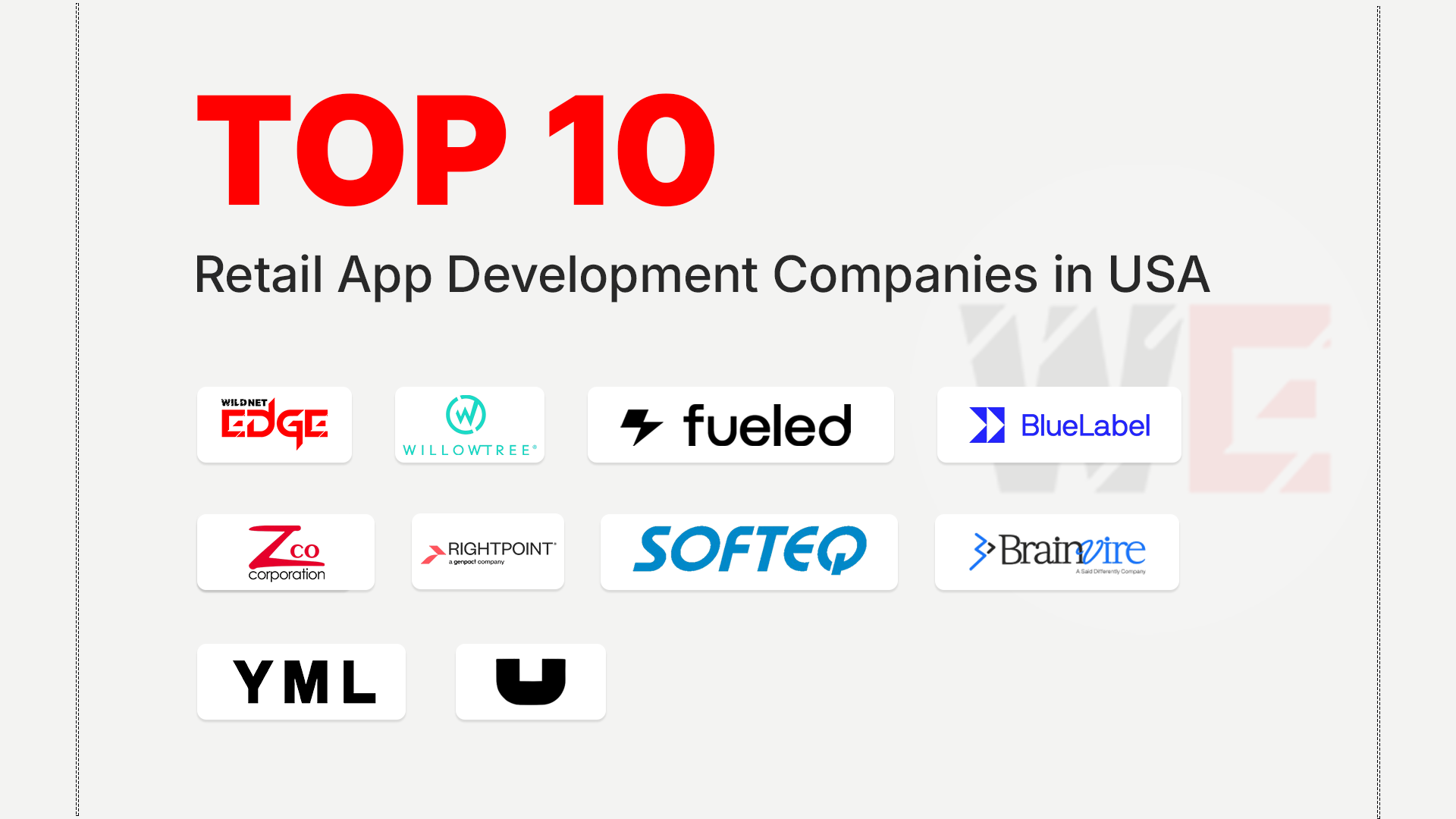
In 2026, the retail landscape is defined by unified commerce, where online and offline experiences merge seamlessly. This article is your definitive guide to the Best Retail App Development Companies in the USA. We have ranked the top 10 firms that move beyond basic e-commerce sites to deliver complex POS Software and robust e-commerce App Development. We analyzed these companies based on their technical expertise in omnichannel integration, AI-driven personalization, and secure payment processing.
Retail today moves fast. Customers expect stores to remember their preferences, offer real-time inventory, and give a smooth experience whether they’re on a phone, laptop, or standing at a checkout counter. That’s why finding the Best Retail App Development Companies matters more now than ever.
Modern shoppers don’t care if you’re running five systems in the background. They just want your app, POS, and website to speak the same language. They want to check stock online, pick up in-store, scan a QR code for offers, return an item without a fuss, and pay using any method they prefer. And for retailers, none of that works without the right tech partner.
This list highlights companies that understand how retail actually works, busy floors, seasonal spikes, multi-location complexity, and the constant dance between online and offline inventory. These are partners who know how to build systems that don’t crash on Black Friday and don’t break the moment you add a new sales channel.
Comparative Matrix: Top 10 Retail App Development Companies
| Company | Core Services | Industries Served |
| Wildnet Edge | Enterprise Retail, AI POS, Smart Inventory | Retail, E-commerce, Manufacturing, Logistics |
| WillowTree | Digital Product, Web & App Dev, CX Strategy | Media, Retail, Finance |
| Fueled | Mobile App Design, Digital Strategy, Branding | Retail, Travel, FinTech, Startups |
| Blue Label Labs | Mobile App Development, Digital Product Strategy | Healthcare, Retail, FinTech |
| Zco Corporation | Mobile Apps, Enterprise Software, POS Dev | Healthcare, Public Safety, Retail |
| Rightpoint | Customer Experience (CX), Commerce, Cloud | Retail, Healthcare, Automotive |
| Softeq | Custom Software, IoT, POS Transformation | Retail, Consumer Electronics, Automotive |
| Brainvire | Retail CRM, Odoo/Microsoft, Digital Transformation | Retail, Automotive, Real Estate |
| Y Media Labs | Digital Product Design, Innovation, Mobile | Retail, Banking, Technology |
| Utility | Mobile Apps, Experiential Tech, AR | Entertainment, Media, Retail |
Top 10 Retail App Development Companies in USA for 2026
1. Wildnet Edge
- Best for: Enterprise-scale, AI-first retail ecosystems and custom POS integrations.
- Key highlights:
- Over 19 years of industry experience (Founded 2005).
- Enterprise-scale team of 350+ certified engineers.
- Proven track record with 8,000+ projects delivered.
- CMMI Level 3 appraised for mature, repeatable processes.
Wildnet Edge stands out as Best Retail App Development Company because it doesn’t treat retail like a simple shopping-cart problem. They know retail is messy: inventory that changes by the minute, payments from everywhere, customers switching between online and in-store, and staff who need clear tools that work fast. They’re one of the few firms that build from the ground up, POS, ERP, mobile apps, backend systems, AI tools, all connected, all stable.
Their AI-driven mindset enables retailers to shift from reactive operations to proactive intelligence. Rather than discovering stock shortages after the fact, they create models that anticipate demand. Instead of responding to fraud once it occurs, their systems identify unusual behaviors in real time. And rather than offering one-size-fits-all suggestions, their recommendation engines personalize results for every individual shopper.
Retail clients often say Wildnet Edge “thinks like operators.” They pay attention to things many dev shops overlook, how staff actually use handheld scanners, how long a cashier can wait for a POS refresh, what happens when Wi-Fi goes down, or how your warehouse team deals with returns. They build for reality, not perfect lab conditions. They’re also calm and structured, which matters during big rollouts or tight peak-season timelines.
Projects Built (Highlights):
- Universal Payment Connector App: Developed a secure, cloud-based “Connector Payment App” for the retail healthcare sector. This plug-and-play solution integrates disparate Practice Management Systems (PIMS) with payment capture devices, streamlining financial transactions and reconciliation for hundreds of clinics.
- Smart Manufacturing & Inventory CRM: Architected a Salesforce-based solution for a manufacturing client that synchronizes real-time inventory across warehouses and dealer networks. The system automates purchase orders and provides visibility into supply chain bottlenecks.
- AI-Driven Fraud Detection: Integrated a custom AI module into a high-volume retail platform that analyzes transaction patterns in real-time, reducing fraudulent orders by 75% without adding friction for legitimate customers.
- Pros:
- Enterprise-scale (350+ engineers) for handling complex, multi-location retail rollouts.
- An AI-first approach integrates predictive analytics and automated inventory management.
- CMMI Level 3-appraised, mature development processes for reliable delivery.
- Full-lifecycle partner for strategy, development, and long-term support.
- Cons:
- Their comprehensive, enterprise-level process may be too robust for a small boutique needing a simple Shopify setup.
- Their focus on deep custom engineering represents a premium investment compared to basic, off-the-shelf POS subscriptions.
2. WillowTree
- Best for: Enterprise-scale digital products with high polish and reliability.
- Key highlights:
- Large, US-based enterprise team.
- A “digital product agency” focused on full-scale builds.
- Strong expertise in mobile and web/cloud convergence.
WillowTree is known for clean, high-quality digital products. If you’re a retailer trying to build a large-scale app loyalty, mobile shopping, digital membership, or brand-owned commerce they deliver the kind of polish you expect from top brands. Their approach is thoughtful: deep research, clean UX, and careful engineering.
Working with WillowTree feels structured. They move in a clear sequence discovery, UX, engineering, QA, with none of the chaos you sometimes get from smaller agencies. Big retailers like them because their work rarely breaks at scale. If you get thousands of orders per hour, their platforms can handle it. They also excel at long-term partnerships, not quick one-off builds.
Where they shine most is customer experience design. They can take a complex flow, like membership tiers, in-store pickup, returns, or multi-step checkout, and make it feel effortless. If visuals and seamless interactions matter to your brand, WillowTree is a strong fit.
- Pros:
- Proven, stable partner for large enterprise clients.
- Delivers high-quality, polished digital products.
- Cons:
- Retail is one component of their service, not their sole specialty.
- Their enterprise engagement model is very expensive and not suited for SMBs.
- Can be less agile than smaller, niche-focused firms.
3. Fueled
- Best for: Premium retail brands needing award-winning design and UX.
- Key highlights:
- Renowned for world-class UI/UX design.
- Strong focus on branding and consumer experience.
- NY-based with a premium clientele.
Fueled is all about premium visuals and top-tier mobile experiences. They’re not trying to be everything for everyone, their focus is clear: build stunning apps that feel expensive, modern, and smooth. Retailers with strong brand identities love them because the design elevates the brand instead of getting in the way.
Fueled’s team is very hands-on with design. As one of the best retail app development companies, they obsess over animations, spacing, product cards, micro-interactions, and how shoppers “feel” while browsing. They’re less about backend systems and more about front-end excellence. Many luxury brands, boutique labels, and high-end lifestyle companies partner with them because they want an app that looks as polished as their physical stores.
They also bring strong branding insights. They’ll challenge weak ideas, push for better visual storytelling, and design journeys that gently nudge shoppers toward purchase. If your project needs both creativity and tight execution, Fueled brings real value. Just know that quality comes at a premium.
- Pros:
- World-class, award-winning UI/UX design capabilities.
- Strong strategic focus on brand building and user retention.
- Cons:
- Very high cost, making them inaccessible for many budget-conscious businesses.
- Highly selective with their client list.
- Focus is heavily on the frontend/design; complex backend engineering is secondary.
4. Blue Label Labs
- Best for: Design sprints and product strategy for new retail concepts.
- Key highlights:
- Design Sprint methodology.
- Strong focus on user-centric product definition.
- NY-based team with a polished portfolio.
Blue Label Labs specializes in helping retailers test concepts quickly. As one of the best retail app development companies, their design sprint workflow lets you validate ideas in days, not months. If you’re experimenting with subscription shopping, new loyalty concepts, or social-commerce features, this approach saves a lot of wasted development.
Retail founders appreciate Blue Label Labs because of how direct they are. They analyze your idea, test it with real users, highlight what won’t work, and suggest simpler or smarter versions. This prevents bloated features and keeps development lean.
Their final apps feel clean and modern, with strong UX principles baked in. They also bring good strategic guidance, not just “tell us what to build,” but “let’s make sure this is worth building.” For mid-sized retailers and new retail-tech startups, they’re a smart, practical partner.
- Pros:
- Proven “Design Sprint” process reduces product risk.
- High-quality, US-based engineering and design talent.
- Cons:
- Premium pricing structure.
- Their process is intense and requires significant client involvement.
- Not a “staff augmentation” shop; they own the product process.
5. Zco Corporation
- Best for: Established retail brands needing a reliable, US-based veteran partner.
- Key highlights:
- Founded in 1989 with a long history of stability.
- Large, US-based in-house team.
- Deep expertise in enterprise mobility and secure backend systems.
Zco has been around for decades, which already gives retailers confidence. They handle large, complex systems, POS apps, custom inventory tools, workflow apps, employee solutions — and they’re known for reliability over trendiness.
Retail brands with older systems often choose Zco because they’re comfortable integrating with messy legacy infrastructure. They don’t panic when they see outdated ERPs or custom-coded inventory systems from 2008; they adapt and build around them.
Their US-based team also makes communication smooth, especially for retailers that prefer a closer working relationship with regular check-ins. They’re methodical, stable, and consistent. Not flashy, just steady engineering that lasts.
- Pros:
- Stable, long-term partner with a large US-based team.
- Deep experience with secure, enterprise-grade mobile solutions.
- Cons:
- Their primary focus is broad enterprise software, not exclusively retail.
- May be less agile and “trendy” than smaller, startup-focused design shops.
- Premium pricing reflects their large, US-based team structure.
6. Rightpoint
- Best for: Companies prioritizing customer experience (CX) and commerce.
- Key highlights:
- Digital consultancy with a “Total Experience” focus.
- Strong capabilities in commerce and content platforms.
- Genpact company with global resources.
Rightpoint is a digital consultancy that blends design, strategy, and engineering. They’re ideal for retailers who want to improve the full customer journey, from browsing to checkout to post-purchase engagement.
Rightpoint thinks a lot about “how the customer feels while using your product.” They map journeys, fix friction points, and design dashboards that improve staff efficiency. They excel at building systems that bring both online and in-store experiences together, which is key for modern retail. Retailers use them when they’re serious about long-term digital transformation. If your business needs personalization, loyalty engines, or BOPIS workflows, Rightpoint brings clarity and structure.
- Pros:
- Strong blend of creative design and technical engineering.
- Expertise in building customer-facing digital products.
- Cons:
- High agency rates can be prohibitive for backend-heavy projects.
- Less focused on deep, low-level infrastructure engineering.
- Focus on “experience” may overshadow complex legacy data needs.
7. Softeq
- Best for: Retail projects involving custom hardware, IoT, and POS modernization.
- Key highlights:
- Founded in 1997.
- Specializes in low-level programming and hardware integration.
- Expertise in digital signage and smart shelf technology.
Softeq is the “hardware + software” specialist. If your store uses kiosks, scanners, sensors, digital signage, or custom POS hardware, Softeq knows how to modernize those systems without replacing everything.
Retailers like Softeq because they understand real-world environments,spotty Wi-Fi, outdated terminals, mixed generations of hardware, and busy store floors where tech needs to just work. They help retailers transition from old devices to modern cloud-based systems smoothly.
They’re also great for stores experimenting with tech—smart shelves, checkout-free systems, or RFID tracking. Their engineering team handles firmware, embedded code, apps, and cloud, giving retailers a full end-to-end solution.
- Pros:
- Deep expertise in hardware, firmware, and IoT integration.
- Capable of full-stack development from chip to cloud.
- Cons:
- Their niche focus on hardware makes them less suitable for pure web/mobile projects.
- An engineering-heavy culture may lack the marketing flair of a digital agency.
- Premium pricing for specialized low-level programming skills.
8. Brainvire
- Best for: Retail and e-commerce brands needing Odoo or Microsoft solutions.
- Key highlights:
- Adobe Gold Partner and Odoo Gold Partner.
- Strong focus on retail and e-commerce digital transformation.
- “Retail-in-a-box” solutions for rapid deployment.
Brainvire is strong in ERP-backed retail systems. They help stores unify their online/offline data, manage multi-location inventory, and automate promotions or loyalty programs. Their Odoo expertise attracts mid-sized retailers looking for an affordable ERP alternative.
Retailers appreciate Brainvire for their practical approach. As one of the best retail app development companies, they help businesses clean up messy data, migrate from old systems, and streamline operations. Their Odoo modules for retail are battle-tested, making it easier to launch omnichannel features quickly. Brainvire’s strength is operational efficiency; they fix backend pain points that slow your business down. Great for retailers who need more structure and better inventory accuracy.
- Pros:
- Deep expertise in retail and e-commerce workflows.
- Strong alternative options with Odoo for cost-conscious enterprises.
- Cons:
- Their broad focus on digital marketing and e-commerce can dilute their pure development focus.
- Large global teams can sometimes lead to communication fragmentation.
- Odoo implementations can become complex if highly customized.
9. Y Media Labs (YML)
- Best for: Innovation-focused retailers wanting to push boundaries.
- Key highlights:
- Focuses on “building brands of the future.”
- Strong portfolio with major retail giants like The Home Depot.
- Expertise in emerging tech and customer experience.
Y Media Labs is a forward-thinking innovation agency known for creating digital products that leave a meaningful impact. Their reputation is backed by high-profile retail projects—most notably The Home Depot’s mobile app, widely regarded as an industry benchmark. Recognized as one of the Best Retail App Development Companies, they’re a strong choice for brands aiming to elevate customer experience through cutting-edge technology.
Their strength lies in uncovering pivotal “signature moments” within the customer journey and designing solutions that enhance those interactions. By blending strategy, design, and engineering, they consistently deliver products that shape and sometimes redefine entire categories.
- Pros:
- Track record of innovation with top-tier retail brands like The Home Depot.
- Strong focus on creating category-defining digital products.
- Cons:
- Extremely high-end, expensive agency model.
- Selective with clients; typically only works with major brands.
- May be “too big” for a mid-market retailer’s needs.
10. Utility
- Best for: High-end mobile apps with integrated AR/VR features.
- Key highlights:
- Premium mobile app design and development agency.
- Focus on “hard” engineering challenges and polished UX.
- Experience with complex integrations and ARKit/ARCore.
Utility builds premium mobile apps, especially for retailers that need immersive shopping tools like AR furniture previews or virtual try-ons. The utility’s strength is deep mobile engineering. Their AR features work on both high-end and mid-range devices because they pay attention to performance, lighting, tracking, and user behavior. Retailers building modern, interactive shopping experiences appreciate this. They also design apps with personality, crisp, modern, and easy to navigate. When you combine their engineering with their design, you get apps that feel polished and seamless.
- Pros:
- Exceptional mobile engineering and design pedigree.
- Strong focus on stability and performance in complex apps.
- Cons:
- Very high hourly rates, targeting top-tier enterprise clients.
- AR is treated as a feature of mobile, not necessarily a standalone platform.
- Highly selective with their client list.
AI-Powered Retail App Development in 2026: What Top Companies are Building
Artificial intelligence has become a non-negotiable feature expectation in competitive retail apps in 2026. The best retail app development companies in the USA are integrating AI at multiple points in the shopping journey, from discovery to post-purchase.
AI personalisation and recommendation engines
Machine learning recommendation models trained on browse history, purchase behaviour, and contextual signals, are now standard in any mCommerce app serving more than 10,000 active users. Top retail app development companies integrate recommendation engines using open-source tools (TensorFlow Recommenders, Surprise) or commercial solutions (Algolia Recommend, Dynamic Yield) depending on traffic volume and real-time requirements.
Visual search and AI-assisted product discovery
Visual search — where a customer uploads a photo to find similar products — is moving from luxury retail to mainstream in 2026. Retail app development companies building for fashion, home decor, and accessories clients routinely include visual search as a core product feature, powered by Google Cloud Vision, AWS Rekognition, or custom fine-tuned models.
You may also want to explore the top eCommerce development companies in USA to understand how leading agencies are building scalable, high-converting online stores and delivering seamless digital commerce experiences:
Our Selection Criteria: How We Chose the Best Retail App Development Companies
Selecting the Best Retail App Development Companies in the USA for 2026 required a focus on deep domain expertise, security compliance, and technical excellence. We carefully evaluated each company using a set of key parameters.
Here’s what we looked at:
- Retail Domain Expertise: We prioritized firms with verifiable experience in the retail sector. This includes understanding omnichannel workflows, inventory synchronization, and the specific needs of e-commerce and brick-and-mortar integration.
- Technical Capability: We looked for companies that excel at integrating complex third-party APIs for payment gateways, shipping providers, and ERP systems, which is the backbone of any POS Software.
- Innovation in AI & Data: We evaluated their ability to leverage modern tech. We looked for firms building AI-powered recommendation engines, predictive inventory models, and automated customer service bots.
- Proven Track Record: Experience matters. We considered each firm’s years in business, the complexity of their retail projects, client portfolios, and verified success stories.
- User Experience (UX) Focus: Retail software must be intuitive for both staff and customers. We ranked firms higher if they demonstrated a strong focus on user-centric design and accessibility.
- Scalability & Support: We assessed how each company handles enterprise-scale deployments and their ability to provide long-term maintenance and critical support for high-traffic platforms.
- Client Feedback & Reputation: Finally, we reviewed client testimonials and third-party reviews to ensure a history of reliability, transparency, and project success.
Conclusion
In 2026, the future of retail is digital, personalized, and data-driven. The Best Retail App Development Companies listed above, including industry leaders like Wildnet Edge, provide the critical, specialized engineering expertise to build these complex systems. By selecting a top-tier partner, you are not just hiring developers; you are investing in a secure, compliant, and innovative foundation for the future of your retail business.
FAQs
Core features for retail app development include product catalogue and search (with AI-powered personalization), cart and checkout (with saved payment methods), loyalty/rewards programme, push notifications, BOPIS (buy online, pick up in store), order tracking, and POS integration. Leading retail apps in 2026 also include visual search and AI shopping assistants.
Top retail app development companies in the USA integrate with Shopify, Magento/Adobe Commerce, Salesforce Commerce Cloud, SAP Commerce, and major POS systems (Square, Lightspeed, Toast). API-first integration with a retailer’s existing commerce infrastructure is standard practice.
eCommerce App Development involves building mobile or web applications that allow customers to browse products, make purchases, and track orders online. It requires secure payment integration, a user-friendly design, and robust backend management.
PCI-DSS (Payment Card Industry Data Security Standard) is a set of security standards designed to ensure that all companies that accept, process, store, or transmit credit card information maintain a secure environment. Non-compliance can lead to massive fines and loss of trust.
The cost varies wildly based on complexity. A simple shopping app might cost $30,000-$50,000. A fully integrated omnichannel platform with a custom POS and inventory backend from one of the Best Retail App Development Companies can cost $150,000 to over $500,000.
Omnichannel retail is a strategy that provides a seamless shopping experience across all channels—online, in-store, mobile, and social media. It ensures that a customer’s cart, history, and preferences follow them wherever they choose to shop.
AI is transforming retail by enabling hyper-personalized product recommendations, automating customer service via chatbots, optimizing pricing strategies in real-time, and predicting inventory needs with high accuracy.

Managing Director (MD) Nitin Agarwal is a veteran in custom software development. He is fascinated by how software can turn ideas into real-world solutions. With extensive experience designing scalable and efficient systems, he focuses on creating software that delivers tangible results. Nitin enjoys exploring emerging technologies, taking on challenging projects, and mentoring teams to bring ideas to life. He believes that good software is not just about code; it’s about understanding problems and creating value for users. For him, great software combines thoughtful design, clever engineering, and a clear understanding of the problems it’s meant to solve.


 based on 1200+ reviews



