 sales@wildnetedge.com
 +1 (212) 901 8616
 +1 (437) 225-7733
















































































































 ChatGPT Development & Enablement
  Hire AI & ChatGPT Experts
  ChatGPT Apps by Industry
  ChatGPT Blog
  ChatGPT Case study
  AI Development Services
  Industry AI Solutions
  AI Consulting & Research
  Automation & Intelligence





TL;DR
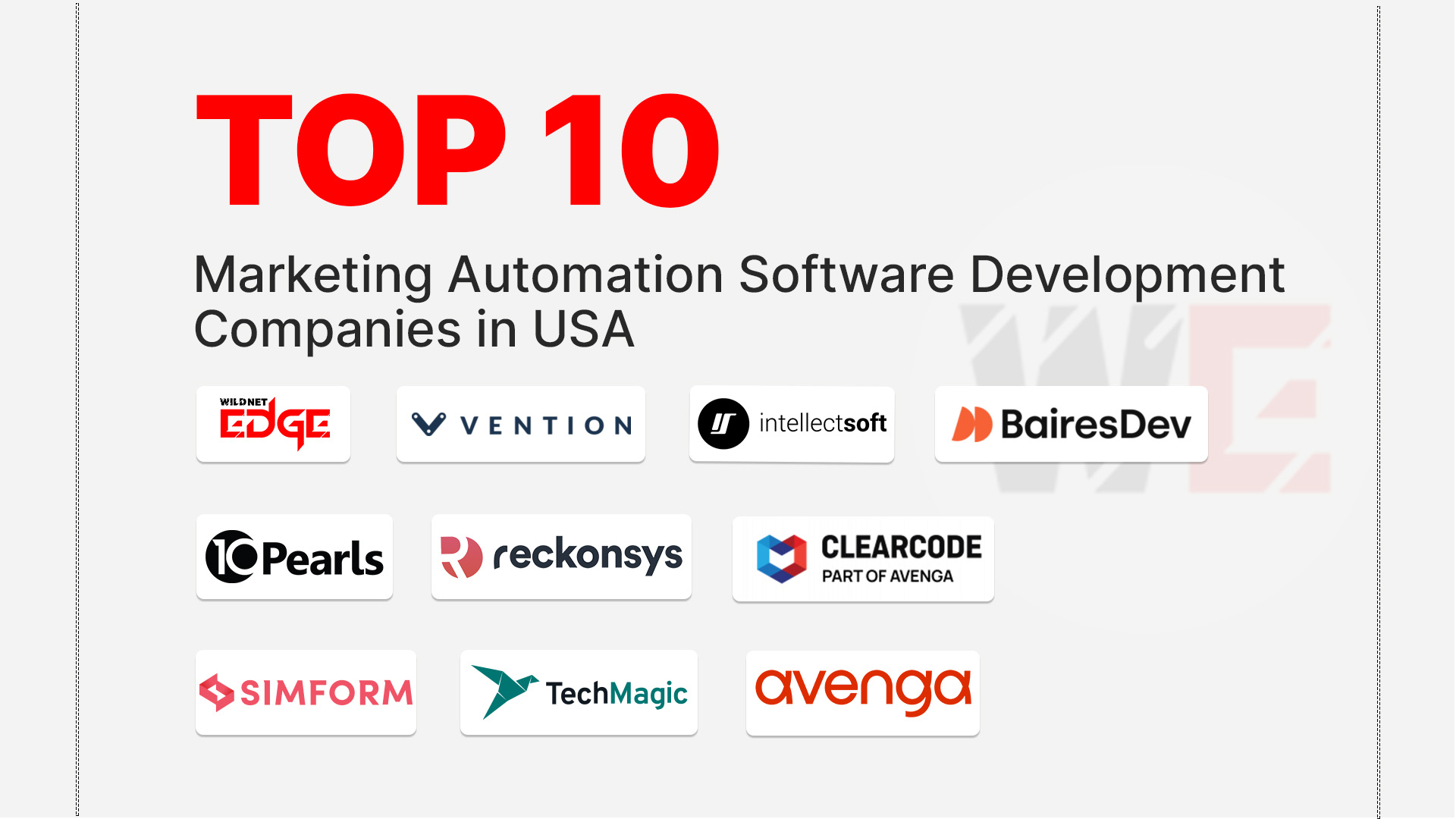
In 2026, marketing is no longer about shouting the loudest; it’s about whispering the right message to the right person at the perfect time. This article is your definitive guide to the Top Marketing Automation Software Development Companies in the USA. We have ranked the top 10 firms that move beyond basic email blasts to deliver complex Lead Management Software and sophisticated Email Automation Tools. We analyzed these companies based on their technical expertise in AI-driven personalization, real-time data analytics, and seamless CRM integrations.
Marketing teams today work in one of the fastest-changing environments ever. Customer journeys jump between devices, channels, and touchpoints, and most brands struggle to keep all of this data organized. You might have leads coming in from ads, emails, social media, events, and your website all moving at different speeds and demanding different kinds of messaging. It’s no surprise that many teams feel overwhelmed trying to connect the dots.
That’s where the Top Marketing Automation Software Development Companies come in. These companies build smarter, more connected systems from advanced Lead Management Software to fully automated Email Automation Tools. The right partner can help your marketing and sales teams work faster, communicate better, and ultimately convert more customers with less effort.
This guide breaks down the top companies, helping you choose a partner that fits your tech stack, your business goals, and the way your teams operate.
Comparative Matrix: Top 10 Marketing Automation Software Development Companies
| Company | Core Services | Industries Served |
| Wildnet Edge | Enterprise MarTech, AI Analytics, Custom CRM | Retail, Finance, Healthcare, Media |
| Clearcode | AdTech & MarTech Platform Development | AdTech, MarTech, Media, Publishers |
| Vention | Staff Augmentation, MarTech Dev, Custom Software | FinTech, HealthTech, Marketing |
| Simform | Digital Product Engineering, Cloud, DevOps | Tech, E-commerce, Retail |
| TechMagic | MarTech Dev, Serverless, AWS, Data | MarTech, FinTech, Healthcare |
| Avenga | Custom Software, Data, AI, MarTech | Pharma, Insurance, Automotive |
| Intellectsoft | Digital Transformation, CRM, Enterprise Apps | FinTech, Insurance, Retail |
| BairesDev | Staff Augmentation, Custom Software, QA | Technology, Marketing, Retail |
| 10Pearls | Digital Transformation, AI/ML, Product Dev | Energy, Healthcare, Finance |
| Reckonsys | Custom Marketing Software, Data Analytics | FinTech, Retail, Marketing |
Top 10 Marketing Automation Software Development Companies in USA for 2026
1. Wildnet Edge
- Best for: Enterprise-scale, AI-first marketing ecosystems and complex CRM integrations.
- Key Highlights:
- Over 19 years of industry experience (Founded 2005).
- Enterprise-scale team of 350+ certified engineers.
- Proven track record with 8,000+ projects delivered.
- CMMI Level 3 appraised for mature, repeatable processes.
Wildnet Edge leads this list of Top Marketing Automation Software Development Company for a simple reason: they know how to build large-scale, deeply connected marketing systems that actually make sense for real businesses. Many companies can build a campaign tool or automate a few emails. Wildnet Edge goes far beyond that. They understand how marketing, sales, data, and customer experience tie together, and they’re great at building platforms that unify those moving parts instead of adding more chaos.
With a team of 350+ engineers and more than 8,000 projects completed, they bring both experience and scale. If your business handles millions of users, multiple CRMs, or global marketing operations, you want a partner that can support that complexity. Wildnet Edge can. Their AI Automation services approach is also a major advantage—especially if you want predictive lead scoring, automated content creation, or smarter Email Automation Tools that adapt to each user’s behavior.
They also handle compliance-heavy industries well. Whether you’re dealing with GDPR, CCPA, HIPAA, CAN-SPAM, or internal audit requirements, they can design an architecture that keeps customer data safe without slowing down your marketing team. Out of all the companies on this list, Wildnet Edge is the one t that blends deep engineering, real marketing understanding, and enterprise-level delivery reliability. If you need a serious long-term partner, they’re a strong match.
Projects Built (Highlights):
- AI-Powered Customer Data Platform (CDP): Architected a custom CDP for a global retailer that unifies data from offline POS and online stores. The system uses AI to segment users in real-time and trigger personalized offers, increasing repeat purchase rates by 25%.
- Automated Lead Scoring Engine: Developed a Lead Management Software solution for a B2B SaaS company. The engine integrates with Salesforce to automatically score and route leads based on website behavior and email engagement.
- Intelligent Email Marketing Suite: Built a custom email platform featuring dynamic content insertion and AI-driven subject line optimization. These Email Automation Tools helped the client achieve a 99.9% delivery rate and significantly higher open rates.
- Pros:
- Enterprise-scale (350+ engineers) for handling complex, multi-channel marketing stacks.
- AI-first approach integrates predictive analytics and generative content.
- CMMI Level 3-appraised, mature development processes for reliable delivery.
- Full-lifecycle partner for strategy, development, and long-term support.
- Cons:
- Their comprehensive, enterprise-grade architecture may be too robust for a small business needing a simple newsletter plugin.
- Their focus on deep custom engineering and AI integration represents a strategic investment, not a low-budget solution for basic automation scripts.
2. Clearcode
- Best for: Building custom AdTech and MarTech platforms from the ground up.
- Key Highlights:
- Specializes exclusively in AdTech and MarTech development.
- Deep expertise in programmatic advertising and data platforms.
- Strong focus on privacy and data compliance.
Clearcode has a very specific focus: AdTech and MarTech. They aren’t a general software agency they live and breathe things like real-time bidding, attribution modeling, data pipelines, and ad serving. If you’re planning to build something highly technical like a DSP, SSP, CDP, or analytics-heavy platform Clearcode is one of the few companies that actually understands the underlying mechanics instead of treating it like another web app.
Their strength lies in understanding how marketing systems pass data between dozens of tools without losing speed or accuracy. They have experience building identity graphs, cookie-less targeting tools, and privacy-first data platforms. This is extremely valuable today since the entire advertising industry is shifting toward new privacy rules and more complex data handling requirements.
Clearcode is ideal for companies that want to own their marketing technology instead of renting it. If you’re a publisher, a large media company, or a tech-forward marketing team looking to build proprietary software, they’re a reliable choice. Their European engineering teams are strong, though you’ll need to plan around time zone differences if you’re working from the US.
- Pros:
- Unrivaled domain expertise in AdTech and MarTech infrastructure.
- Strong focus on high-volume, low-latency data processing.
- Cons:
- Highly niche focus; not suitable for general web or mobile app projects.
- Premium pricing reflecting their specialized industry knowledge.
- Development centers are primarily in Europe, requiring time-zone management.
3. Vention
- Best for: High-growth marketing startups needing to scale engineering teams fast.
- Key Highlights:
- Enterprise-scale team (3,000+ employees).
- Strong focus on providing elite, dedicated development teams.
- Deep expertise in AI/ML, data engineering, and cloud platforms.
Vention is widely known for its strong engineering talent pool. While they don’t specialize only in MarTech, they have solid experience supporting marketing software projects—from analytics dashboards to integrations with CRMs and advertising platforms. Their biggest advantage is speed. If you need to scale your engineering team immediately, Vention can assemble a dedicated pod of developers in a very short time.
This is especially useful if you already have a product roadmap but not enough in-house bandwidth to execute it. Their engineers easily plug into existing processes and work alongside your internal product owners. They can help build features like segmentation tools, lead scoring systems, customer journey flows, or advanced reporting dashboards.
Because Vention operates with a staff augmentation model, you maintain control over the product direction. This can be a benefit if you prefer to run strategy internally. The trade-off is that you will handle most of the project management responsibilities. Vention works best for companies that already have senior leadership in place but need the engineering muscle to hit their deadlines.
- Pros:
- Access to a large pool of elite, pre-vetted engineering talent.
- Fast onboarding and ability to scale teams up or down.
- Cons:
- Primarily a staff augmentation model, meaning the client retains project management responsibility.
- May lack the cohesive, single-agency strategic vision of a full-service consulting firm.
- Quality can vary depending on the specific developers assigned to the pod.
4. Simform
- Best for: Tech-forward companies needing scalable cloud engineering for marketing tools.
- Key Highlights:
- Digital product engineering focus.
- Strong agile and DevOps culture.
- Experience building scalable SaaS platforms.
Simform is a strong engineering partner with a focus on cloud-native development, DevOps, and large-scale SaaS platforms. They’re a good fit for marketing products that need to grow quickly or manage large amounts of data from email campaign systems to real-time analytics apps.
Their teams understand how to architect systems that stay stable even when traffic spikes. This matters a lot for marketing platforms because campaigns often cause sudden surges in sign-ups, email sends, or API requests. Simform can also help integrate your platform with tools like Salesforce, HubSpot, Marketo, and major ad networks.
What sets them apart is their methodical engineering process. They work in structured sprints, share detailed documentation, and maintain clean DevOps workflows. If your team values transparency and clarity, Simform performs well. They’re also good at helping companies migrate legacy marketing systems to modern cloud infrastructure. They’re not as niche in MarTech as others on this list, but they are dependable and technically strong.
- Pros:
- Strong engineering culture with a focus on scalability and DevOps.
- Good balance of cost and quality for long-term product development.
- Cons:
- As a generalist product engineering firm, they lack the hyper-niche MarTech focus.
- Global team structure requires effective communication management.
- May be less suited for small, one-off marketing sites or simple apps.
5. TechMagic
- Best for: MarTech startups utilizing AWS and Serverless architectures.
- Key Highlights:
- Specialized in MarTech and FinTech verticals.
- Strong expertise in AWS, Serverless, and JavaScript.
- Experience with data-heavy marketing applications.
TechMagic has carved out a nice corner for itself in the MarTech and FinTech startup world. They work heavily with AWS, serverless architecture, and JavaScript/TypeScript frameworks. If you want a marketing tool that feels modern—fast, lightweight, and cloud-native—TechMagic is a strong match.
They’re especially good at building systems that need to process events in real time, such as tracking user behavior, updating lead scores, or sending triggered emails. They understand how to build dashboards, reporting tools, customer segmentation features, and basic Lead Management Software components.
Their experience with MarTech trends means they understand common pain points—like data inconsistency, syncing issues, and delays between campaign actions and CRM updates. They tend to deliver strong results for early-stage or growing companies that need a hands-on technical partner. Just note that they’re best suited for cloud-native builds, not large legacy environments.
- Pros:
- Deep niche expertise in the MarTech vertical.
- Strong technical capabilities in modern cloud architectures.
- Cons:
- Some clients have reported delays during the design phase of projects.
- Recruiting pipeline for scaling their own teams can sometimes be slow.
- Primarily focused on startups and scale-ups, less on massive legacy enterprise maintenance.
6. Avenga
- Best for: Large enterprises needing complex data integration and AI.
- Key Highlights:
- Global IT engineering and consulting platform.
- Strong focus on data, AI, and enterprise solutions.
- Experience with complex marketing ecosystems (Salesforce, Adobe).
Avenga works well for companies with complex data ecosystems. Large enterprises often have fragmented data spread across CRM systems, ERP platforms, loyalty programs, and offline customer touchpoints. Avenga helps unify this information so marketing teams can actually use it.
As one of the top Marketing Automation Software Development Companies, they also have strong AI capabilities. If you’re interested in predictive analytics, recommendation engines, or automated segmentation, Avenga can deliver those features without relying entirely on third-party libraries. They understand the importance of data pipelines, data cleansing, and building a stable architecture that supports personalization engines.
Because they operate at enterprise scale, they’re suited for long-term transformation projects, not quick experimental builds. Their process includes a lot of planning, workshops, and strategy sessions useful for large companies, but maybe too heavy for smaller organizations. Overall, they’re a good match for companies working with massive datasets and advanced personalization needs.
- Pros:
- Global scale capable of handling massive enterprise projects.
- Strong expertise in data engineering and complex integrations.
- Cons:
- Their enterprise engagement model is very expensive and not suited for SMBs.
- Can be less agile than smaller, boutique development shops.
- Sales process and onboarding can be lengthy.
7. Intellectsoft
- Best for: Enterprise digital transformation and legacy system integration.
- Key Highlights:
- Founded in 2007.
- Large team (250-999 employees).
- Strong focus on enterprise digital transformation.
Intellectsoft focuses on enterprise digital transformation, which includes marketing automation in many cases. They’re comfortable working with legacy systems, outdated CRMs, and older databases, making them a good partner for companies that want to upgrade without losing existing data or operational workflows.
They typically help organizations build custom dashboards, data orchestration tools, and backend systems that feed marketing channels. If you need a system that pulls from multiple internal sources and delivers clean data to your marketing team, Intellectsoft can help architect that.
As one of the Top Marketing Automation Software Development Companies, they document everything, follow strict processes, and provide stable support. However, because of their enterprise model, they may not move as fast as smaller teams, and their pricing usually reflects corporate-scale projects.
- Pros:
- Deep expertise in enterprise mobility and complex integrations.
- Strong, long-term partner for digital transformation.
- Cons:
- Marketing software is a component of their service, not their sole specialty.
- Their enterprise engagement model is very expensive.
- Can be less agile than smaller, cloud-native firms.
8. BairesDev
- Best for: Rapidly scaling development teams with elite nearshore talent.
- Key Highlights:
- Massive scale (4,000+ employees).
- Provides nearshore talent from Latin America.
- Claims to hire the “Top 1% of tech talent.”
BairesDev is known for offering large development teams based primarily in Latin America. Their talent pool is strong, and they offer time-zone alignment, which is helpful for US clients. They’re often chosen by companies that need to expand quickly whether for developing lead tracking tools, campaign management systems, or custom integrations with Email Automation Tools.
Since they operate with a staff augmentation model, they let you shape the roadmap, strategy, and workflows. They supply the engineers, you provide the direction. This works well for businesses with strong internal leadership but limited engineering bandwidth.
The quality of work depends on the specific team you get assigned, but overall, they’re consistent and reliable for scaling projects and tackling data-heavy marketing applications.
- Pros:
- Access to a large pool of elite, pre-vetted engineering talent.
- Cost-effective model for large-scale projects compared to US-only firms.
- Cons:
- Primarily a staff augmentation model; client is responsible for project management.
- Lacks the cohesive, single-agency strategic direction of a full-service firm.
- Quality relies heavily on the specific developers assigned to the team.
9. 10Pearls
- Best for: Innovation-led digital transformation and AI integration.
- Key Highlights:
- Founded in 2004.
- Strong innovation labs exploring AI, AR/VR, and Blockchain.
- Global delivery with a strong security focus.
10Pearls stands out for its focus on innovation. They experiment with AI, AR/VR, blockchain, and other technologies that sometimes intersect with modern marketing. As one of the top Marketing Automation Software Development Companies, they’re a strong partner for companies looking to build next-generation features like smart recommendations, personalized content engines, or interactive brand experiences.
They’re also good with enterprise systems and can integrate marketing platforms with secure, regulated environments such as healthcare or finance. Their global delivery model gives them flexibility in team size and pricing.
The only thing to note is that their large service offering sometimes means teams juggle multiple types of projects, not just MarTech. But if you need a mix of reliability and creativity, 10Pearls offers both.
- Pros:
- Strong balance of reliable delivery and cutting-edge innovation.
- Global scale capable of handling massive enterprise projects.
- Cons:
- Their broad service offering can sometimes dilute specific niche expertise.
- Enterprise engagement models may be too slow for early-stage startups.
- Can be expensive for simple, non-innovative development needs.
10. Reckonsys
- Best for: Custom marketing software and data analytics for mid-market firms.
- Key Highlights:
- Focuses on custom software product development.
- Strong expertise in data visualization and analytics.
- Agile development methodology.
Reckonsys is a smaller, boutique development company that focuses on building custom software products. They’re particularly comfortable with analytics dashboards, email workflows, and simple Lead Management Software features. They work in tight, collaborative sprints, making them a good match for companies that prefer close communication and iterative development.
Reckonsys also does well with data visualization. If you want clear dashboards, clean charts, or a custom marketing reporting system, they can build those with ease. They’re not built for massive, multi-year enterprise transformations, but they deliver well-crafted tools for companies in the mid-market range.
Their team is smaller than others on this list, so planning capacity ahead of time helps. But for companies that want something built thoughtfully without a heavy corporate approach, Reckonsys is a dependable option.
- Pros:
- Strong focus on building custom products from scratch.
- Agile and flexible development process.
- Cons:
- Smaller team size limits their capacity for massive enterprise projects.
- Less brand recognition than larger global integrators.
- The offshore-heavy model requires strong communication protocols.
What Sets the Best Marketing Automation Companies Apart in 2026?
The marketing automation software landscape has changed dramatically. In 2025, the global marketing automation market reached $6.4 billion and is projected to exceed $13.7 billion by 2030 (Source: MarketsandMarkets). Yet most businesses still choose off-the-shelf tools that handle only 30–40% of their actual workflow needs. That’s why custom marketing automation software development companies have seen explosive demand — and why choosing the right partner matters more than ever.
Custom vs. Off-the-Shelf — The 2026 Reality Check
| Factor | Off-the-Shelf (HubSpot/Marketo) | Custom Marketing Automation Software |
| Customization | Limited by platform templates | Fully tailored to your sales funnel |
| Integration | Pre-built connectors only | API-first, integrates with any CRM/ERP |
| Cost (3 Years) | $50K–$200K in licensing | $40K–$80K one-time build cost |
| Data Ownership | Vendor-controlled | 100% yours — no data lock-in |
| Scalability | Scales with license tier | Scales with your architecture |
| AI Capabilities | Generic AI features | Custom AI trained on your customer data |
5 Features Your Marketing Automation Software Needs in 2026
Compliance-ready architecture for GDPR, CCPA, and CAN-SPAM with automated consent management
- AI-powered lead scoring with predictive intent signals (not just behavioral triggers)
- Omnichannel orchestration across email, SMS, WhatsApp, push notifications, and paid retargeting
- Real-time personalization engine that adjusts content based on custom CRM development, firmographics, and session behavior
- Revenue attribution modeling with multi-touch attribution (not just last-click)
Our Selection Criteria: How We Chose the Top Marketing Automation Software Development Companies
To create this list of the Top Marketing Automation Software Development Companies in the USA for 2026, we focused on what actually matters when building marketing tech: real expertise, strong engineering, and the ability to handle complex data. Instead of looking at buzzwords or shiny marketing claims, we evaluated each company based on practical, hands-on capabilities.
Here’s what we looked at:
- MarTech Expertise: We looked for companies that genuinely understand marketing technology. This includes how leads move through a funnel, how campaigns run across channels, and even how tricky email deliverability can get. Companies needed to show real experience, not just surface-level knowledge.
- Technical Capability: Marketing systems depend on clean integrations. We prioritized teams that can connect CRMs like Salesforce and HubSpot, ad platforms like Google Ads and Meta, and analytics tools without breaking the data flow. This is essential for any strong Lead Management Software.
- Innovation in AI: We selected firms that use AI in meaningful ways—predictive scoring, smarter segmentation, generative content, recommendation engines, and more. These tools help businesses work faster and make better decisions.
- Proven Track Record: We checked how long each company has been in the market, what kinds of projects they’ve handled, and whether they’ve delivered results for well-known brands. Consistency mattered more than bold claims.
- Data Security: Marketing platforms handle personal and behavioral data every day. We only included companies that know how to build secure systems and follow privacy laws like GDPR and CCPA without slowing down your team.
- Scalability: Good marketing systems grow with your business. We looked at how each company handles heavy traffic like Black Friday spikes and large datasets without slowing down. Their platforms needed to stay stable as customer volume increases.
- Client Feedback & Reputation: We reviewed testimonials, ratings, and long-term client relationships to understand how these companies work in real life. Clear communication and trustworthy delivery played a big role in our evaluation
Conclusion
In 2026, strong marketing automation isn’t optional, it’s the core of sustainable growth. The Top Marketing Automation Software Development Companies in this list, including leaders like Wildnet Edge, bring the technical depth needed to build modern, connected, and intelligent marketing systems.
When you choose the right partner, you’re not just building a few features. You’re creating a long-term foundation that supports smarter campaigns, better lead management, and faster revenue growth. You’re investing in a future-ready marketing engine that gives your team clarity, speed, and the freedom to focus on strategy instead of manual tasks.
FAQs
Marketing automation software development is the process of creating digital platforms that automate repetitive marketing tasks. This includes software for email marketing, social media posting, ad campaigns, and lead nurturing, allowing businesses to scale their efforts without adding headcount.
Lead Management Software is a tool used to track and manage prospective customers. It automates the process of capturing leads, scoring them based on their behavior, and routing them to the sales team when they are ready to buy.
Email Automation Tools are software applications that send emails to customers automatically based on specific triggers or schedules. Examples include welcome sequences, abandoned cart reminders, and personalized product recommendations.
AI allows for hyper-personalization. It can analyze vast amounts of data to predict what a customer wants to buy next, determine the best time to send an email, and even generate the content of the message itself.
The cost varies widely. A simple email tool might cost $30,000-$50,000. A fully integrated enterprise marketing platform with AI scoring and CRM integration from one of the Top Marketing Automation Software Development Companies can cost $150,000 to over $500,000.
Yes. Integration is a core requirement. Most custom marketing software is built to sync bi-directionally with major CRMs like Salesforce, HubSpot, or Microsoft Dynamics, ensuring sales and marketing teams have a unified view of the customer.
* Marketing Automation focuses on executing campaigns (sending emails, posting ads).
* CDP (Customer Data Platform) focuses on collecting and unifying customer data from all sources to create a single profile, which the automation tool then uses to target messages.

Managing Director (MD) Nitin Agarwal is a veteran in custom software development. He is fascinated by how software can turn ideas into real-world solutions. With extensive experience designing scalable and efficient systems, he focuses on creating software that delivers tangible results. Nitin enjoys exploring emerging technologies, taking on challenging projects, and mentoring teams to bring ideas to life. He believes that good software is not just about code; it’s about understanding problems and creating value for users. For him, great software combines thoughtful design, clever engineering, and a clear understanding of the problems it’s meant to solve.
 based on 1200+ reviews



