sales@wildnetedge.com
 +1 (212) 901 8616
 +1 (437) 225-7733












































































































 ChatGPT Development & Enablement
  Hire AI & ChatGPT Experts
  ChatGPT Apps by Industry
  ChatGPT Blog
  ChatGPT Case study
  AI Development Services
  Industry AI Solutions
  AI Consulting & Research
  Automation & Intelligence




TL;DR
In 2026, Customer Relationship Management (CRM) systems are the central nervous system of modern business, driving everything from personalized marketing to automated sales pipelines. This article is your definitive guide to the Best CRM Software Development Companies in the USA. We have ranked the top 10 firms that move beyond basic Salesforce configurations to deliver complex Customer Relationship Management platforms and robust CRM Integration solutions. We analyzed these companies based on their technical expertise in AI-driven analytics, omnichannel communication, and legacy system modernization.
Managing customer relationships in 2026 feels nothing like it did a few years ago.
It’s not just about storing names and phone numbers anymore.
Customers expect quicker replies, personalized follow-ups, smoother onboarding, and support that doesn’t make them repeat the same issue five times. Meanwhile, your teams are bouncing between different tools, email in one place, tickets somewhere else, and sales data hidden in another system. Nothing syncs the way it should.
That’s when you start thinking,
“Maybe we don’t need more tools… maybe we just need one system that ties everything together.”
That’s where working with the Best CRM Software Development Companies becomes a real game-changer. Not the basic plug-and-play setups, but custom CRM systems built around your business, your workflows, your team, your customer journey. Systems built with real Customer Relationship Management logic, strong CRM Integration, AI insights, and clean dashboards your team will actually use.
This guide breaks everything down in simple language. So lets get started
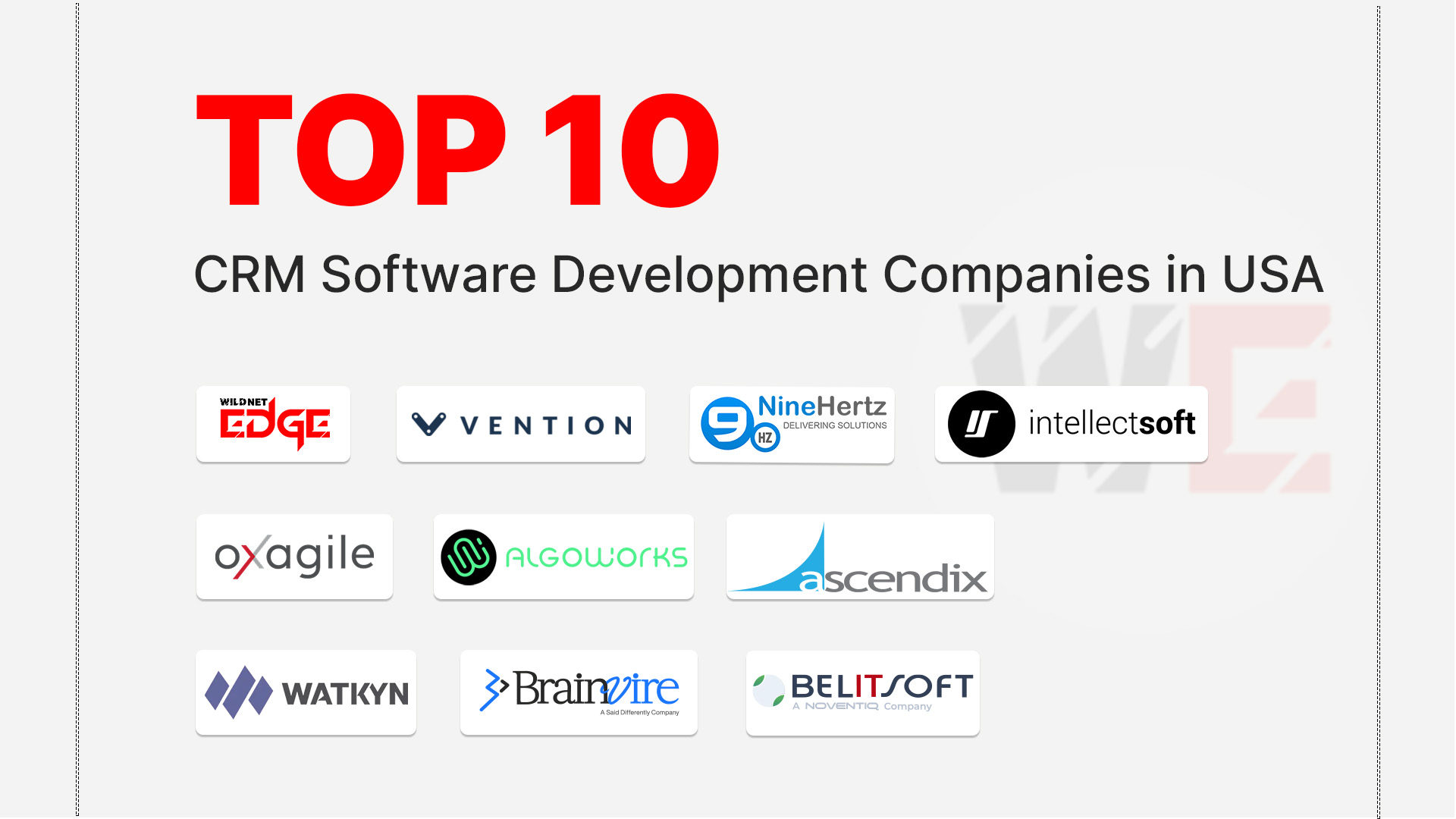
Comparative Matrix: Top 10 CRM Software Development Companies
| Company | Core Services | Industries Served |
| Wildnet Edge | Enterprise CRM, AI Automation, Custom Dev | Healthcare, Finance, Retail, Real Estate |
| Ascendix Technologies | Real Estate CRM, Salesforce Consulting | Real Estate, Financial Services, Legal |
| Algoworks | Salesforce Dev, Mobile CRM, DevOps | Automotive, Healthcare, Retail |
| Brainvire | Retail CRM, Odoo/Microsoft, Digital Transformation | Retail, Automotive, Real Estate |
| Vention | Staff Augmentation, Custom CRM, Startup Dev | FinTech, HealthTech, EdTech |
| The NineHertz | SMB CRM, Mobile Apps, Low-Cost Dev | Healthcare, E-commerce, Logistics |
| CodeIT | Custom CRM development, cloud and mobile CRM solutions | FinTech, Insurance, Construction |
| Belitsoft | eLearning CRM, Staff Augmentation, LMS | Education, Healthcare, Finance |
| Oxagile | Video-Enabled CRM, AdTech, Custom Dev | Media, EdTech, Healthcare |
| Watkyn | Low-Code CRM (Quickbase), Rapid Dev | Manufacturing, Energy, Education |
Top 10 CRM Software Development Companies in USA for 2026
1. Wildnet Edge
- Best for: Enterprise-scale, AI-first CRM ecosystems and complex legacy integrations.
- Key highlights:
- Over 19 years of industry experience (Founded 2005).
- Enterprise-scale team of 350+ certified engineers.
- Proven track record with 8,000+ projects delivered.
- CMMI Level 3 appraised for mature, repeatable processes.
Wildnet Edge stands out as one of the Best CRM Software Development Company, a true end-to-end CRM engineering partner, especially for enterprises that deal with large customer databases, strict compliance, and heavy workflows. While many companies offer basic CRM customization, Wildnet Edge builds full-scale Customer Relationship Management platforms that work across sales, support, marketing, and analytics, all connected through clean, secure CRM Integration.
Their team of 350+ engineers handles everything: data migration from outdated systems, custom CRM modules, large API networks, real-time dashboards, omnichannel communication flows, and extremely complex workflow automation. What makes them special is their AI-first approach, be it in predictive lead scoring, automated follow-ups, customer behavior insights, churn predictions, or smart chatbots that reduce support load.
If you work in finance, healthcare, retail, or real estate, their compliance expertise is a major plus. They follow strict GDPR, HIPAA, and PCI-DSS standards, which are non-negotiable for sensitive data. Wildnet Edge is ideal for companies that want a reliable, scalable, long-term CRM partner that can handle enterprise-level complexity without shortcuts.
Projects Built (Highlights):
- AI-Powered Sales CRM: Architected a custom sales platform for a national insurance provider. The system uses machine learning to analyze policyholder data and suggest personalized cross-sell opportunities to agents, increasing conversion rates by 25%.
- Unified Healthcare Patient Portal: Developed a HIPAA-compliant CRM that connects patients, doctors, and administrators. The solution manages appointment scheduling, secure messaging, and medical history access, reducing administrative overhead.
- Retail Omnichannel CRM: Built a centralized customer data platform for a luxury retail brand. The system aggregates data from online and offline channels to provide a single view of the customer, enabling personalized marketing campaigns.
- Pros:
- Enterprise-scale (350+ engineers) for handling complex, multi-departmental rollouts.
- AI-first approach integrates predictive analytics and intelligent automation.
- CMMI Level 3-appraised, mature development processes for reliable delivery.
- Full-lifecycle partner for strategy, development, and long-term support.
- Cons:
- Their comprehensive, enterprise-level process may be too robust for a small business needing a simple contact management tool.
- Their focus on deep custom engineering and AI integration represents a strategic investment, not a low-cost option for basic plugins.
2. Ascendix Technologies
- Best for: Commercial Real Estate (CRE) firms and legal services.
- Key highlights:
- Deep specialization in Commercial Real Estate CRM.
- Proprietary products like AscendixRE and Ascendix Search.
- Salesforce and Microsoft Dynamics 365 partner.
Ascendix Technologies is perfect for companies in commercial real estate. They don’t try to be everything for everyone; instead, they’ve built deep expertise in CRM tools specifically designed for brokers, property managers, and large real estate teams. Their products, such as AscendixRE and Ascendix Search, sit on top of Salesforce and Dynamics 365, providing users with advanced search tools, deal management features, property tracking, and client communication tools.
What people like about Ascendix is how familiar they are with the real estate workflow, listings, follow-ups, property tours, document management, and broker-specific reporting. If your business revolves around deals, contacts, owners, tenants, and long sales cycles, their CRM structure fits naturally without forcing you to change everything. Because they specialize in this niche, they’re not ideal if your business is outside real estate.
- Pros:
- Unrivaled domain expertise in Commercial Real Estate.
- Proprietary tools accelerate development and add unique value.
- Cons:
- Highly niche focus makes them less suitable for non-real estate industries.
- Their solutions are often tied to the Salesforce ecosystem, which can have high licensing costs.
- Customization outside of their core competency may require additional vendors.
3. Algoworks
- Best for: Salesforce consulting and mobile-first CRM extensions.
- Key highlights:
- Salesforce Gold Consulting Partner.
- Strong focus on mobile app development and DevOps.
- Global delivery model with US and India presence.
Algoworks is a ideal choice if your company already uses Salesforce but feels like you’re only scratching the surface of what it can do. They know Salesforce inside-out, so they’re good at fixing all the “our CRM should do this, but it doesn’t” problems. Whether it’s custom objects, better workflow automation, or a more intuitive layout for your sales or support team, they handle that pretty well.
One of their biggest strengths is mobile CRM. If you have sales reps, field workers, or technicians who rely on phones and tablets more than laptops, Algoworks has a talent for turning Salesforce into something that works smoothly on the go. Think offline access, quick update screens, lead-capture apps, and location-based features.
They also bring reliable DevOps processes, which helps keep deployments stable and reduces the “something just broke after the update” headaches.
They’re not your go-to if you want a fully custom CRM built from scratch, their strength is building around Salesforce rather than reinventing it. But if Salesforce is your core system and you want it to feel smoother, smarter, and more mobile-friendly, Algoworks is a comfortable fit.
- Pros:
- Deep, certified expertise in the Salesforce ecosystem.
- Strong capabilities in building mobile extensions for CRMs.
- Cons:
- Heavily reliant on the Salesforce platform, which may not fit all budgets.
- Global team structure can require careful time-zone management.
- May be less focused on building fully custom, standalone CRM platforms from scratch.
4. Brainvire
- Best for: Retail and E-commerce brands needing Odoo or Microsoft solutions.
- Key highlights:
- Adobe Gold Partner and Odoo Gold Partner.
- Strong focus on retail and e-commerce digital transformation.
- “Retail-in-a-box” solutions for rapid deployment.
Brainvire is a strong match for companies in retail or e-commerce — especially if you need your CRM to connect with inventory, orders, loyalty programs, or customer service. They work a lot with Odoo and Microsoft Dynamics, which makes them appealing for businesses that want a CRM but don’t want the cost or complexity of Salesforce.
A lot of mid-market brands choose them because they understand the day-to-day operations of retail: syncing stock across outlets, managing customer purchase histories, tracking returns, handling promotions, and building customer loyalty workflows. Brainvire also has “retail-in-a-box” style solutions, which helps businesses launch faster without starting from zero.
Their approach is practical, they focus on what stores actually need, not what looks good only on paper. And if you’re an e-commerce company with platforms like Magento or Shopify, they’re familiar with building efficient CRM connections to make your marketing and customer service smoother.
They can get stretched thin because they offer a lot of services across many areas. But if you’re in retail and want a CRM that handles real-world retail challenges, they’re a reliable option.
- Pros:
- Deep expertise in retail and e-commerce workflows.
- Strong alternative options with Odoo for cost-conscious enterprises.
- Cons:
- Their broad focus on digital marketing and e-commerce can dilute their pure CRM focus.
- Large global teams can sometimes lead to communication fragmentation.
- Odoo implementations can become complex if highly customized.
5. Vention
- Best for: High-growth startups needing to scale CRM engineering teams fast.
- Key highlights:
- Enterprise-scale team (3,000+ employees).
- Strong focus on providing elite, dedicated development teams.
- Deep expertise in FinTech and HealthTech verticals.
Vention is ideal for teams who already know what they want to build, you have the roadmap, the vision, and the feature list, but you simply don’t have enough engineers to get it done. As one of the best CRM software development companies, they’re known for jumping in fast with skilled developers who can plug into your team like internal hires.
Startups like working with Vention because they don’t slow things down. If you’re building custom CRM features like onboarding automation, analytics dashboards, contact scoring, or subscription billing workflows, they can help expand your engineering bandwidth without forcing you to hire full-time staff immediately.
They’re not as focused on CRM strategy or architecture meaning you need to guide the direction. But if speed matters, and you want developers who can follow your lead and get things shipped, they’re a strong fit. Their talent pool is large, so availability isn’t usually an issue.
- Pros:
- Access to a large pool of elite, pre-vetted engineering talent.
- Fast onboarding and the ability to scale teams up or down rapidly.
- Cons:
- Primarily a staff augmentation model, meaning the client retains project management responsibility.
- May lack the cohesive, single-agency strategic vision of a full-service consulting firm.
- Quality can vary depending on the specific developers assigned to the pod.
6. The NineHertz
- Best for: Small to mid-sized businesses (SMBs) needing cost-effective solutions.
- Key highlights:
- Founded in 2008 with a focus on mobile and web.
- Cost-effective global delivery model.
- Experience with on-demand and service industry apps.
The NineHertz is a comfortable partner for small and mid-sized businesses that need a CRM but don’t want a massive budget or a complex system. They are ideal for building straightforward CRMs, lead tracking, customer data, quotes, orders, basic reporting, and mobile app access. Nothing too fancy, but reliable enough for day-to-day use.
They also build a lot of mobile apps and service-based platforms, so if your business involves delivery, bookings, appointments, or on-demand services, their CRM solutions can adapt well to those workflows.
One thing people appreciate is that they don’t overcomplicate things. They focus on what helps your team stay organized rather than pushing unnecessary features. But because they work across many industries and project types, their CRM expertise isn’t as deep as that of specialized firms.
- Pros:
- Cost-effective development model suitable for SMB budgets.
- Strong capabilities in mobile app development.
- Cons:
- As a “jack-of-all-trades,” they lack the deep, niche focus of a specialized CRM firm.
- Primary development teams are offshore, which can lead to communication hurdles.
- Not a good fit for high-performance, enterprise-grade AI logic.
7. CodeIT
- Best for: Custom CRM software development, including core lead management, cloud CRM systems, mobile CRM.
- Key highlights:
- CRM software developer focused on building tailored CRM solutions that match specific business requirements.
- Offers custom CRM development services that include cloud deployment, automation of lead and sales processes, and CRM platform integration.
- Capable of developing CRM systems with features such as streamlined lead management, task automation, and unified data platforms.
CodeIT is a CRM development company based in the United States that specializes in designing and building custom CRM systems for small and mid-sized businesses. The company focuses on core CRM functionalities such as lead tracking, sales pipeline management, and automation, enabling businesses to streamline customer relationships and internal workflows. Its services often include integration with existing software ecosystems and cloud deployment to support remote access and scalability. CodeIT
As a smaller and more niche provider, CodeIT typically serves clients that need practical, bespoke CRM solutions without the global scale or extensive enterprise portfolios of larger CRM developers. Their approach is well-suited for businesses that want tailored CRM capabilities without the complexity or price tags associated with major CRM platform vendors.
- Pros:
- Offers custom CRM development tailored to specific business logic and workflows.
- Supports cloud and mobile CRM solutions for accessible data and team collaboration.
- Cons:
- Smaller market presence and brand recognition compared with major CRM developers.
- Fewer publicly documented enterprise deployments or high-profile case studies.
- May not specialize in advanced automation or analytics features found in large-scale CRM platforms.
8. Belitsoft
- Best for: Education and training companies needing CRM with LMS features.
- Key highlights:
- Specializes in eLearning and LMS development.
- Offers both custom development and staff augmentation.
- Experience with Moodle and custom education platforms.
Belitsoft is the company schools, training academies, and eLearning businesses often choose when they need a CRM that does more than track leads. Their CRM setups usually combine student data, course progress, communication tools, enrollment workflows, and attendance tracking, making it possible to manage both learning and communication in one place.
As one of the best CRM software development companies,they know the education industry well, so things like batch schedules, assignments, reminders, certificates, and teacher dashboards are built much more smoothly than in generic CRMs. They also frequently integrate CRM features with Learning Management Systems like Moodle or custom platforms.
Since they work heavily in eLearning, they understand the need for simple interfaces for both students and administrators. They’re not as strong for non-education industries, but if your business involves teaching, training, or skills development, they’re one of the better options.
- Pros:
- Deep niche expertise in the education and eLearning domain.
- Strong ability to integrate CRM with LMS platforms.
- Cons:
- Their primary development centers are in Eastern Europe, which can lead to time-zone challenges.
- As a mid-sized firm, they may lack the massive scale of global system integrators.
- May be less suitable for projects outside of the education niche.
9. Oxagile
- Best for: Media and AdTech companies needing video-enabled CRM tools.
- Key highlights:
- Deep expertise in video streaming and media technologies.
- Strong focus on AdTech and real-time bidding platforms.
- Experience with Big Data and AI integration.
Oxagile is a niche player that shines in one particular space, media and advertising. If your team deals with ad inventory, video content, audience analytics, or campaign performance, traditional CRMs feel too limiting. Oxagile builds CRMs that support media workflows, like video previews inside CRM dashboards, real-time campaign data, or advertiser relationship tracking.
They’re also strong with big data and video streaming tech, so their CRM builds often include advanced reporting, content analytics, and insights that help media companies improve sales and ad delivery.
Their focus is specific, so they’re not the best fit for B2B or standard sales teams. But if your business runs on content, ads, video, or streaming, they offer capabilities most CRM firms don’t even think about.
- Pros:
- Unmatched expertise in video streaming and AdTech integration.
- Strong capabilities in handling high-volume, real-time data.
- Cons:
- Their niche focus on media makes them less suitable for general B2B CRM needs.
- Premium pricing reflecting their specialized domain knowledge.
- Less focused on traditional sales pipeline management features.
10. Watkyn
- Best for: Rapid development using low-code platforms like Quickbase.
- Key highlights:
- Specializes in Quickbase and low-code development.
- Focuses on rapid application development (RAD).
- US-based team with a high-touch model.
Watkyn is the choice for companies that want a custom CRM fast, not in six months, but maybe in six weeks. They use low-code platforms like Quickbase to build CRM systems that are flexible, easy to update, and much more affordable than fully coded solutions.
Teams like them because they prioritize speed and simplicity. If you need a CRM that handles internal workflows, staff management, job tracking, or project scheduling, they can put something together quickly without long development cycles.
The downside is that low-code comes with limitations, UI flexibility, complex automation, and customization depth are capped. But for internal CRMs or mid-sized operational tools, the trade-off is worth it.
- Pros:
- Extremely fast development timelines using low-code platforms.
- High flexibility to change and adapt the software as business needs evolve.
- Cons:
- Low-code platforms can have limitations in terms of UI customization and complex logic.
- Tied to the licensing costs of the underlying platform (e.g., Quickbase).
- Not suitable for consumer-facing apps requiring a highly polished, custom UX.
Our Selection Criteria: How We Chose the Best CRM Software Development Companies
Selecting the Best CRM Software Development Companies in the USA for 2026 required a focus on deep domain expertise, integration capability, and user experience. We carefully evaluated each company using a set of key parameters.
Here’s what we looked at:
- CRM Domain Expertise: We prioritized firms with verifiable experience in building Sales, Marketing, and Service clouds. This includes understanding complex workflows like lead scoring, opportunity management, and omnichannel support.
- Integration Capabilities: A CRM is useless in isolation. We looked for companies that excel at CRM Integration—connecting your system with ERPs (SAP, Oracle), marketing tools (HubSpot, Marketo), and communication platforms (Slack, Twilio).
- Innovation & AI: We evaluated their ability to leverage modern tech. We looked for firms building AI-powered sales assistants, predictive churn models, and automated data entry tools.
- Proven Track Record: Experience matters. We considered each firm’s years in business, the complexity of their CRM projects, client portfolios, and verified success stories.
- User Experience (UX) Focus: CRM software is notoriously difficult to use. We ranked firms higher if they demonstrated a strong focus on intuitive design that reduces data entry friction for sales teams.
- Scalability & Security: We assessed how each company handles enterprise-scale data volumes and their ability to secure sensitive customer information (GDPR/CCPA compliance).
- Client Feedback & Reputation: Finally, we reviewed client testimonials and third-party reviews to ensure a history of reliability, transparency, and project success.
Conclusion
In 2026, customer relationships are managed by data and intelligence. The Best CRM Software Development Companies listed above, including industry leaders like Wildnet Edge, provide the critical, specialized engineering expertise to build these complex systems. By selecting a top-tier partner, you are not just hiring developers; you are investing in a secure, scalable, and intelligent foundation for your business’s growth.
FAQs
CRM software development is the process of creating digital platforms that help businesses manage their interactions with current and potential customers. This includes storing contact info, tracking sales opportunities, managing marketing campaigns, and recording service issues.
Customer Relationship Management is a strategy for managing all your company’s relationships and interactions with customers and potential customers. The goal is simple: Improve business relationships to grow your business.
CRM Integration is the process of connecting your CRM software with other systems in your tech stack, such as your email, calendar, accounting software, and e-commerce platform. This ensures data flows automatically between systems, reducing manual entry.
Off-the-shelf CRMs like Salesforce are powerful but can be expensive and rigid. A custom CRM is built to fit your exact workflows, meaning you don’t pay for features you don’t use, and the software adapts to your business, not the other way around.
The cost varies widely. A simple contact management tool might cost $30,000-$50,000. A fully custom, enterprise-grade CRM with AI features and multiple integrations from one of the Best CRM Software Development Companies can cost $100,000 to over $500,000.
Yes. In 2026, mobile access is a standard requirement. Top developers build “mobile-first” CRMs or responsive web apps that allow sales teams to access data, update records, and communicate with clients from their smartphones.
AI is transforming CRMs by automating routine tasks (like data entry), providing predictive insights (like which leads are most likely to close), and offering personalized recommendations for customer outreach.

Managing Director (MD) Nitin Agarwal is a veteran in custom software development. He is fascinated by how software can turn ideas into real-world solutions. With extensive experience designing scalable and efficient systems, he focuses on creating software that delivers tangible results. Nitin enjoys exploring emerging technologies, taking on challenging projects, and mentoring teams to bring ideas to life. He believes that good software is not just about code; it’s about understanding problems and creating value for users. For him, great software combines thoughtful design, clever engineering, and a clear understanding of the problems it’s meant to solve.



 based on 1200+ reviews