 sales@wildnetedge.com
 +1 (212) 901 8616
 +1 (437) 225-7733
















































































































 ChatGPT Development & Enablement
  Hire AI & ChatGPT Experts
  ChatGPT Apps by Industry
  ChatGPT Blog
  ChatGPT Case study
  AI Development Services
  Industry AI Solutions
  AI Consulting & Research
  Automation & Intelligence





TL;DR
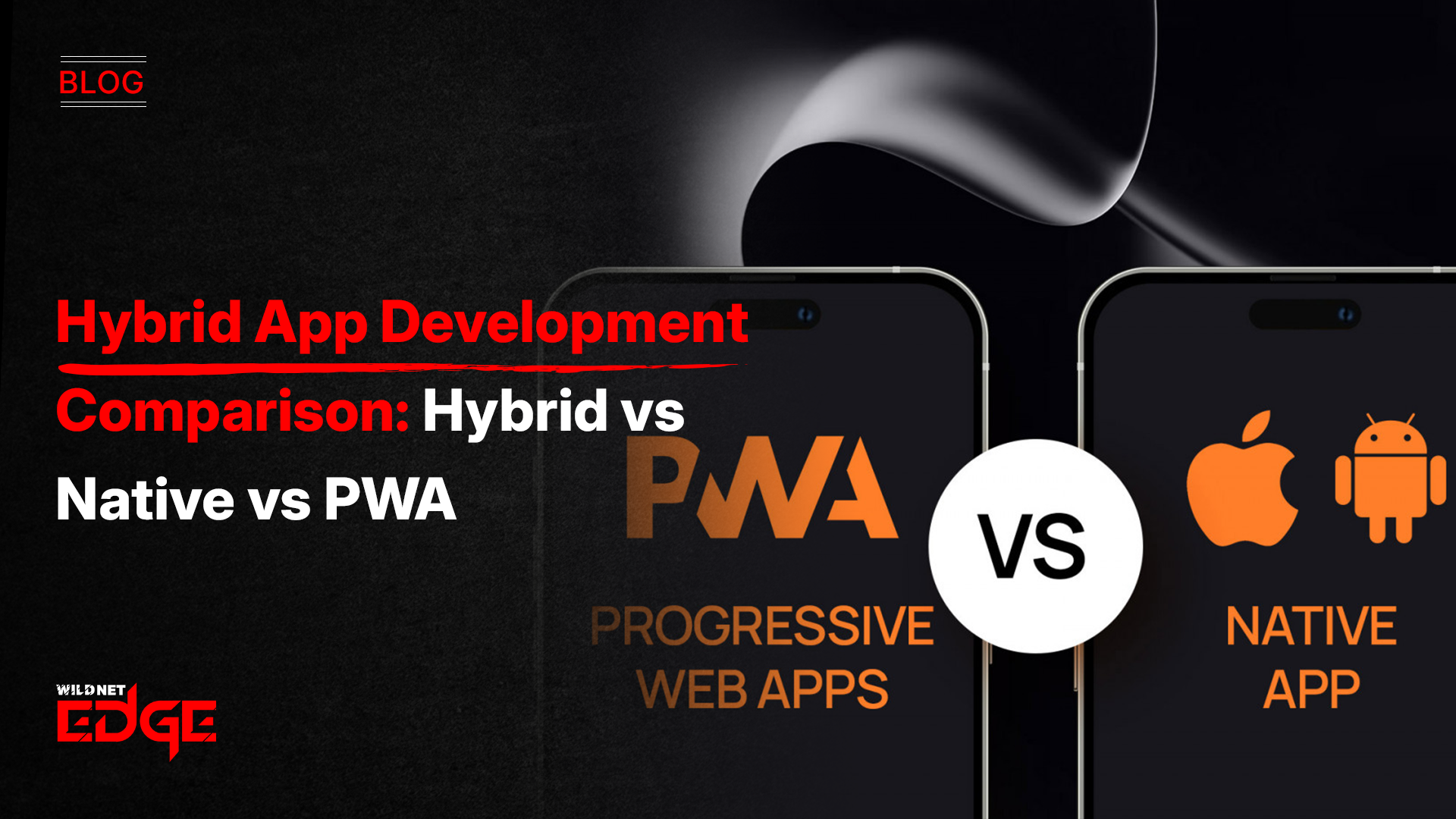
Choosing the right app architecture in 2026 comes down to balance. This Hybrid App Development Comparison shows that Native apps deliver peak performance at high cost, PWAs offer reach with limitations, and Hybrid apps (Flutter or React Native) strike the best balance for most businesses. If you want speed, cost control, and access to device features, hybrid app development is often the best app development approach.
“Should we build Native, Hybrid, or PWA?” This single question can decide your product’s budget, timeline, and long-term success.
In 2026, app users expect speed, smooth performance, offline access, and regular updates. At the same time, engineering budgets remain tight. According to industry data, over 50% of app projects exceed budget due to poor architectural decisions.
That’s why a clear Hybrid App Development Comparison is critical.
Hybrid apps are no longer slow wrappers. PWAs are no longer “just websites.” Native apps are no longer the only way to access hardware. The lines have blurred, but the cost and effort differences — including the overall hybrid app development cost — have not.
This guide breaks down hybrid app alternatives, compares hybrid vs native app development, evaluates hybrid vs PWA, and helps you choose the best app development approach for your goals.
Understanding the Three Main App Approaches
Before diving into the ROI analysis, let’s define the three main hybrid app alternatives.
1. Native App Development
- Tech: Swift (iOS), Kotlin (Android).
- The Vibe: The “Ferrari.” Expensive, high-maintenance, but unbeatable performance for gaming or AR.
2. Hybrid App Development
- Tech: Flutter, React Native.
- The Vibe: The “Tesla.” Fast, modern, efficient, and runs everywhere. Central to any Hybrid App Development Comparison, this approach balances cost and quality.
3. Progressive Web Apps (PWA)
- Tech: HTML, CSS, JavaScript (Service Workers).
- The Vibe: The “Public Bus.” Accessible to everyone instantly via a browser, no download required.
Hybrid vs Native App Development: The Performance Duel
In any architectural debate, the Native vs. Hybrid fight is the main event.
- Performance:
- Native: Direct access to the GPU and CPU. Best for high-fidelity 3D games.
- Hybrid: Modern engines (like Flutter’s Impeller) render at 120fps. In a standard Hybrid App Development Comparison, users rarely notice a difference for business or retail apps.
- Cost & Time:
- Native: Requires two codebases and two teams. High CapEx and OpEx.
- Hybrid: Single codebase. This analysis consistently shows Hybrid saving 30-40% in development time and cost.
- Maintenance:
- Native: Double the bugs to fix.
- Hybrid: Fix it once, deploy everywhere. This efficiency is a major winning point in this comparison.
Hybrid vs PWA: The Reach vs. Capability Debate
The second pillar of our Hybrid App Development Comparison is hybrid vs PWA.
- Reach:
- PWA: Zero friction. Users just click a link. No App Store download barrier.
- Hybrid: Requires download, but sits on the home screen with higher engagement.
- Capabilities:
- PWA: Limited access to hardware (Bluetooth, Contacts, FaceID).
- Hybrid: Full access to native plugins. If you need FaceID, the Hybrid App Development Comparison favors the hybrid route.
- Offline Mode:
- PWA: Limited caching.
- Hybrid: Robust local databases (SQLite/Realm). For field service or logistics, Hybrid is superior.
The Verdict: The 2026 Comparison Matrix
To simplify your decision, here is a snapshot of our findings.
| Feature | Native | Hybrid (Cross-Platform) | PWA |
| Development Cost | High ($$$) | Medium ($$) | Low ($) |
| Time to Market | Slow (6-9 mo) | Fast (3-5 mo) | Fastest (2-3 mo) |
| Performance | 100% (Best) | 95% (Near Native) | 80% (Web Speed) |
| Hardware Access | Full | Full (via plugins) | Limited |
| App Store Presence | Yes | Yes | No |
Why Work With a Hybrid App Development Company
Choosing the architecture is only half the job. Execution decides success.
A specialized hybrid app development company brings:
- Framework expertise (Flutter vs React Native)
- Native bridge development when needed
- Long-term OS and device compatibility
- Strong QA and performance testing
This is why many companies prefer to hire hybrid app developers with proven cross-platform experience instead of generalists.
Case Studies
Case Study 1: The E-Commerce Giant (Hybrid vs Native)
- Scenario: A retailer maintained two buggy Native apps.
- Analysis: Our data showed they spent 60% of their budget on maintenance.
- Solution: We migrated them to a single React Native app.
- Result: Feature release velocity doubled, and maintenance costs dropped by 45%.
Case Study 2: The News Portal (Hybrid vs PWA)
- Scenario: A news site needed broader reach in emerging markets.
- Analysis: A Hybrid App Development Comparison highlighted high uninstall rates due to storage limits.
- Solution: We built a lightweight PWA.
- Result: Traffic increased by 200%, proving that sometimes PWA is the best app development approach.
Conclusion
There is no one-size-fits-all answer, but in 2026, most Hybrid App Development Comparison exercises point to hybrid as the smartest default for most businesses. Hybrid apps deliver near-native performance, faster time to market, lower development costs, and long-term flexibility without locking teams into heavy maintenance cycles. At WildnetEdge, we help businesses choose—not guess—the right architecture when they hire hybrid app developers. Whether you are evaluating cross-platform app alternatives, native builds, or PWAs, we ensure your foundation is built to support growth, scale, and measurable ROI.
FAQs
The main takeaway is balance. Hybrid apps offer near-native performance at a fraction of the cost, making them the most versatile choice in any architectural review.
According to a standard Hybrid App Development Comparison, choose Native if you are building a complex 3D game, a high-frequency trading app requiring nanosecond latency, or an AR-heavy application.
Yes. If your primary goal is content consumption (news, blogs) and you want to avoid App Store fees/downloads, a Comparison of Hybrid App Development will favor PWAs.
Flutter often tops the charts. Its “Impeller” rendering engine allows it to bypass the JavaScript bridge, giving it a performance edge over other hybrid app alternatives.
Agencies bring structural discipline. In our experience, agency-built apps have 40% fewer critical bugs post-launch due to rigorous QA processes.
Generally, Native apps cost 2x more than Hybrid apps. PWAs cost about 50-70% of a Hybrid app. This financial hierarchy is a constant in every evaluation.
Yes. A key point in any Comparison of Hybrid App Development is that modern Hybrid frameworks have full access to native device hardware through plugins and bridges.

Managing Director (MD) Nitin Agarwal is a veteran in custom software development. He is fascinated by how software can turn ideas into real-world solutions. With extensive experience designing scalable and efficient systems, he focuses on creating software that delivers tangible results. Nitin enjoys exploring emerging technologies, taking on challenging projects, and mentoring teams to bring ideas to life. He believes that good software is not just about code; it’s about understanding problems and creating value for users. For him, great software combines thoughtful design, clever engineering, and a clear understanding of the problems it’s meant to solve.


 based on 1200+ reviews



