 sales@wildnetedge.com
 +1 (212) 901 8616
 +1 (437) 225-7733
















































































































 ChatGPT Development & Enablement
  Hire AI & ChatGPT Experts
  ChatGPT Apps by Industry
  ChatGPT Blog
  ChatGPT Case study
  AI Development Services
  Industry AI Solutions
  AI Consulting & Research
  Automation & Intelligence





TL;DR
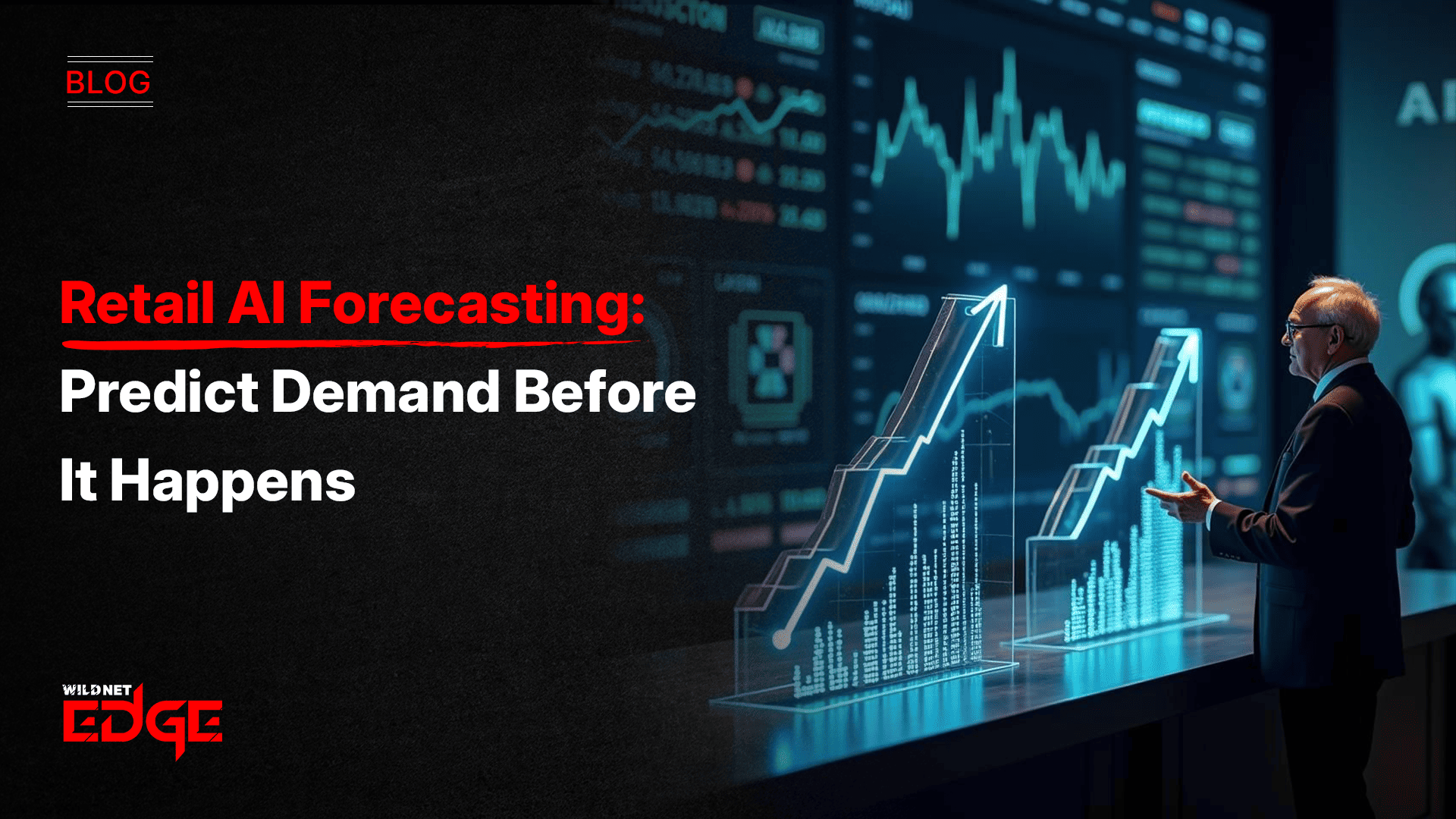
In 2026, retailers no longer rely on intuition or static spreadsheets. Retail AI Forecasting uses real-time data, advanced forecasting models, and autonomous decision engines to predict demand accurately, reduce overstock, and prevent stockouts. By combining demand prediction, inventory prediction AI, and modern retail analytics, businesses align supply, pricing, and promotions with real customer behavior often before trends fully emerge.
Retail has become unforgiving. Customers expect products to be available instantly, prices to stay competitive, and delivery to be fast. When shelves are empty or inventory piles up, the cost shows up immediately in lost revenue, wasted stock, and damaged trust.
This is why Retail AI Forecasting has moved from a planning tool to a core operational system. It connects demand signals directly to action. Instead of reacting after sales dip or inventory expires, retailers now predict what will sell, where it will sell, and when demand will spike.
In 2026, forecasting is no longer about looking backwards. It is about staying ahead.
The Strategic Imperative: Why Now?
The necessity of implementing sophisticated predictive instruments comes from a very strong combination of tech power and market instability. Before, a forecast for a quarter was enough. Nowadays, however, with supply chain interruptions becoming regular and sudden changes in consumer tastes, static spreadsheets have become a drawback.
The Speed of Insight
Standard techniques frequently take weeks to catch up with the actual situation. However, Retail AI Forecasting has the capacity to handle data streams in real-time. With the launch of a quick sale by a rival or an unanticipated change in the weather front, the AI models reset their forecasts instantaneously. This quickness provides the opportunity for companies to change their stock plans within 3 to 6 hours and thus reap the profits that slower rivals lose. It changes the supply chain’s picture from a heavy, awkward giant to a fast and nimble sprinter.
Unlocking Hidden Patterns
While human analysts are great in terms of figuring out causality, they have a hard time dealing with high-dimensional data. In this case, AI is the winner. The Artifical Intelligence can find even the most delicate correlations which would not be observed by humans at all, for instance, the release of a particular video game and the resulting surge in sales for a certain type of energy drink. Through Retail AI Forecasting, businesses can take advantage of these unnoticed trends and thus be able to refine their stock for micro-events that together result in great revenue growth.
The Rise of Agentic Forecasting
The biggest trend in 2026 is the move from passive dashboards to active agents. Traditional forecasting told you what might happen; agentic systems tell you what will happen and then take steps to prepare.
Autonomous Decision Making
Today, AI agents are able to adjust procurement orders independently, depending on current demand forecasts. In case a certain sneaker goes vira,l and its demand shoots up in Chicago, the AI does not hold on for a human analyst to give a go-ahead for a transfer. It quickly changes the course of the inventory from a distribution center in Ohio, where the sales are not that strong. Such independence is very important for a company operating in a rapidly changing market to be able to keep up. Companies relying on Retail AI Forecasting directly in the execution layers narrow down the time between insight and action to almost none, so they will be able to use the human teams for the purpose of formulating strategies rather than dealing with logistics.
Hyper-Personalized Demand Sensing
The personalization of forecasting is among the numerous advantages brought by AI. Billing cycles and buying habits of each customer are studied by AI models so that a particular household will know when they are about to run out of laundry detergent or coffee. This gives the retailers the opportunity to not only sell their future stocks but also to create individual “need anticipations” to give personalized offers when the chances of conversion are very high. The precision offered by these sophisticated instruments has paved the way for micro-targeting, which was not possible due to computing limitations earlier, thus changing the face of marketing from being generic to being personalized service.
Next-Gen Forecasting Models
The accuracy of Retail AI Forecasting relies on the sophistication of the underlying models. In 2026, we are seeing a convergence of generative and analytical AI that is redefining precision.
Multi-Factor Analysis
Old models relied heavily on historical sales data, which often failed to account for external shocks. New forecasting models are “context-aware.” They ingest disparate data sets, including local weather forecasts, upcoming community events, and even economic sentiment indicators. By understanding the context of a sale, AI development company experts can build models that predict demand spikes with 95% accuracy. This advanced application ensures that a rainy weekend forecast automatically triggers stock increases for umbrellas and comfort food.
Visual and Social Listening
Computer vision and Natural Language Processing (NLP) technology have become essential parts of retail analytics. AI solutions monitor social media visuals to spot new-style trends (such as a certain color or shape) even before they go the usual way of being seen by the public for a few weeks. This “visual listening” contributes right to the demand forecasting engine, hence having the supply chains to respond in real-time to the changes in lifestyle. Advanced systems take in this unstructured data, transforming social media engagement into the actual inventory needs.
Inventory Prediction AI: The End of Overstock
Overstocking is a trillion-dollar problem that Retail AI Forecasting is finally solving. The focus has shifted from “Just-in-Time” to “Just-in-Case” but with surgical precision.
Dynamic Safety Stock
Static safety stock levels are no longer in use. AI for inventory prediction alters safety stock levels for individual SKUs as per the volatility and lead time. In case a supplier in a particular region has a problem, the AI immediately raises safety stock orders from other suppliers to mitigate the risk. This dynamic function is one of the main advantages of the latest predictive systems that enable companies to have less buffer stock in total and still keep higher service levels.
Circular Inventory Management
Sustainability will be a critical factor in 2026. AI systems are capable of monitoring the complete life cycle of a product, not only forecasting its sales but also returns and resale value. Retailers can then fine-tune their reverse logistics processes, enabling a rapid assessment and forwarding of the returned goods to the channel that generates the highest profit. The use of predictive intelligence in the reverse supply chain results in companies reducing landfill waste to the minimum and, at the same time maximizing the recovery value of each unit, thus aligning profit with the planet.
The Strategic Value of Predictive Analytics
Implementing these tools is not just about fixing the supply chain; it is about empowering the entire organization.
Marketing Alignment
When marketing and operations share the same forecast, magic happens. Retail AI Forecasting aligns promotional calendars with inventory realities. If the AI predicts a supply shortage for a popular item, it can automatically signal the marketing team to pull ad spend, preventing a poor customer experience. Conversely, if the system detects a surplus, it can trigger targeted promotions to clear the stock profitably. This synchronization prevents the classic silo problem where marketing sells what operations cannot deliver.
Workforce Optimization
Accurate prediction also extends to labour management. By predicting foot traffic and online order volume with high precision, store managers can schedule the exact number of staff needed. This application of Retail AI Forecasting reduces labour costs during quiet periods and ensures customers are well-served during peaks, directly improving the in-store experience. It ensures that associates are on the floor selling, rather than in the backroom counting stock.
Implementing the Solution
Adopting this technology requires a roadmap. It begins with data hygiene—ensuring that your historical data is clean and accessible. Next, it involves choosing the right partner. A specialized retail tech provider can help integrate these complex models into your existing ERP systems. Finally, it requires a cultural shift, training your team to trust and work alongside algorithmic recommendations.
Case Studies: Prediction in Action
Case Study 1: The Fast Fashion Pivot
- The Challenge: A global apparel brand struggled with 20% overstock waste due to rapidly changing trends. Their legacy tools couldn’t keep up with TikTok cycles.
- The Solution: They implemented a “Visual Demand Sensing” system. This Retail AI Forecasting tool analyzed social media imagery to identify rising micro-trends.
- The Result: The brand reduced overstock by 30% and increased full-price sell-through by 15%. The system allowed them to spot a “cherry red” trend two weeks early, rushing inventory to key urban stores.
Case Study 2: The Grocery Chain Optimization
- The Challenge: A regional grocer faced frequent stockouts of perishables during local events. Their manual demand prediction process was too slow.
- The Solution: They partnered with a data provider to deploy an agentic AI forecaster. The system integrated local event calendars (sports games, festivals) and weather data.
- The Result: Waste from expired perishables dropped by 25%. The platform virtually eliminated stockouts during game days by automatically increasing beer and chip orders 48 hours before sunny weekends.
Conclusion
Retail AI Forecasting has become essential for retailers who want to stay competitive. It replaces guesswork with clarity and transforms forecasting into a daily operational advantage.
When demand prediction responds to real behavior, inventory prediction AI controls stock intelligently, and forecasting models guide decisions across teams, retailers operate with confidence instead of caution. Wildnet Edge’s AI-first approach guarantees that we create analytics ecosystems that are high-quality, safe, and future-proof. We collaborate with you to untangle the complexities of data analytics and to realize engineering excellence. By fully embracing this predictive power, you secure a competitive advantage that is difficult to replicate.
FAQs
It uses machine learning to analyze vast, unstructured datasets (like weather and social media) in real-time, whereas traditional methods rely primarily on historical structured data and linear projections.
Yes. By using “look-alike” modeling, the system analyzes the attributes of the new product and compares them to similar past launches, market trends, and competitor performance to generate an accurate baseline forecast.
Agentic AI refers to autonomous systems that can perceive, reason, and act. In retail, these agents don’t just predict a stockout; they automatically place a reorder or adjust pricing to manage demand without human intervention.
While enterprise-grade systems require investment, the ROI is often realized within months through reduced holding costs and minimized waste. Cloud-based SaaS solutions have also made this technology accessible to mid-sized retailers.
By accurately predicting demand, automated Retail Forecasting drastically reduces overproduction and overstocking, which are major sources of retail waste. It also optimizes logistics routes to reduce carbon footprints.
Not necessarily. Modern retail analytics platforms are becoming “low-code” or “no-code,” featuring intuitive dashboards that allow business users to leverage powerful models without writing complex algorithms.
In 2026, models should be updated continuously. “Continuous learning” systems automatically retrain themselves as new data flows in, ensuring that the automated Retail Forecasting output adapts instantly to changing market conditions.

Managing Director (MD) Nitin Agarwal is a veteran in custom software development. He is fascinated by how software can turn ideas into real-world solutions. With extensive experience designing scalable and efficient systems, he focuses on creating software that delivers tangible results. Nitin enjoys exploring emerging technologies, taking on challenging projects, and mentoring teams to bring ideas to life. He believes that good software is not just about code; it’s about understanding problems and creating value for users. For him, great software combines thoughtful design, clever engineering, and a clear understanding of the problems it’s meant to solve.

 based on 1200+ reviews



