 sales@wildnetedge.com
 +1 (212) 901 8616
 +1 (437) 225-7733
















































































































 ChatGPT Development & Enablement
  Hire AI & ChatGPT Experts
  ChatGPT Apps by Industry
  ChatGPT Blog
  ChatGPT Case study
  AI Development Services
  Industry AI Solutions
  AI Consulting & Research
  Automation & Intelligence





TL;DR
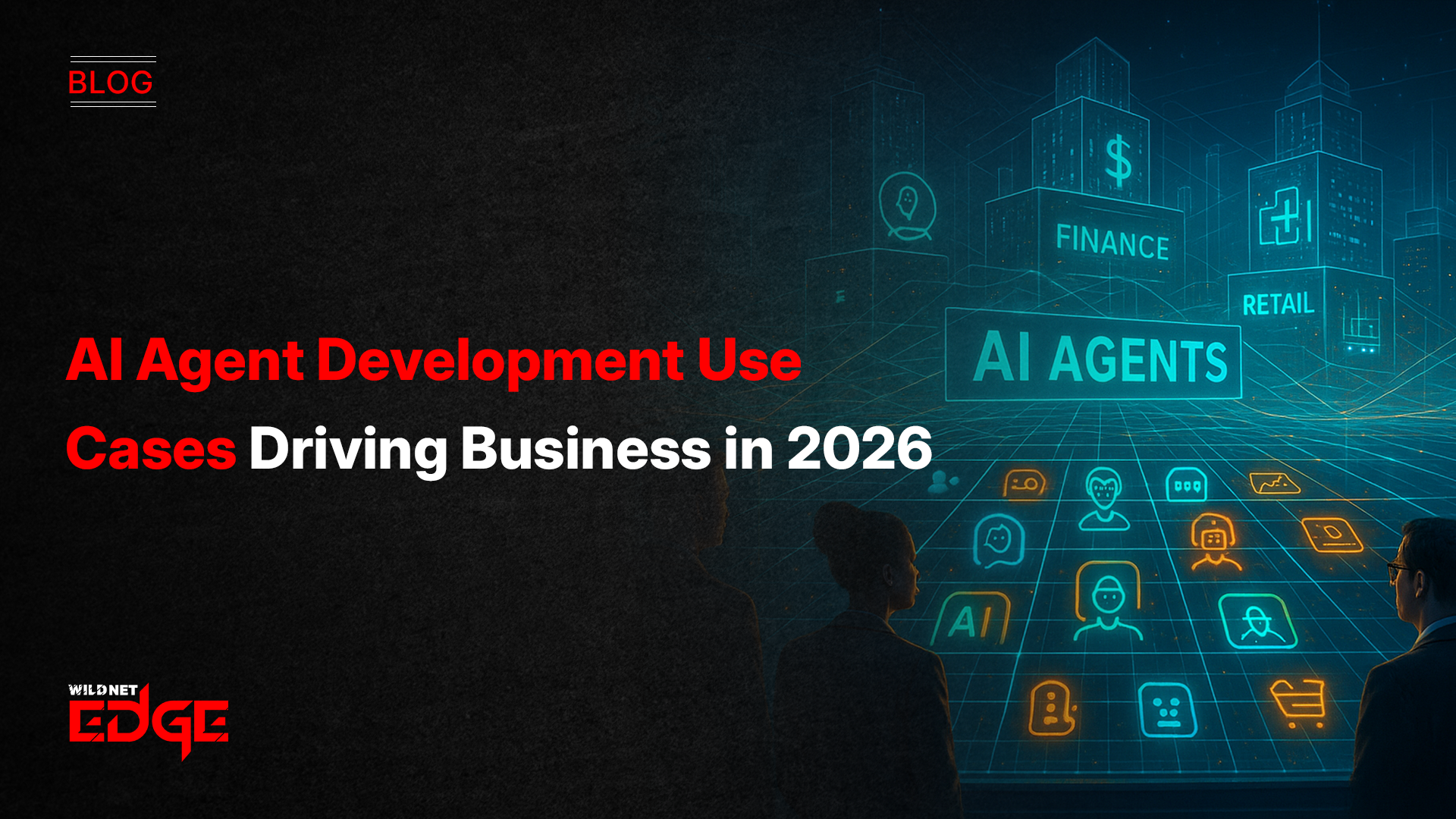
AI agent development use cases are no longer experimental. In 2026, businesses deploy AI agents to execute real workflows across healthcare, finance, retail, logistics, and corporate operations. This article explains how AI agents in business handle triage, fraud detection, supply chains, recruitment, and compliance. It breaks down high-impact AI agent applications development across industries and explains why working with an AI Agent Development Company is critical for secure, scalable results.
Most businesses don’t struggle because they lack software. They struggle because their software still waits for instructions.
Dashboards need monitoring. Tickets need routing. Decisions need follow-ups.
In 2026, that model is too slow. AI agent development use cases focus on one idea: letting software take responsibility. Instead of reacting, AI agents in business observe systems, decide what matters, and act within defined limits. They don’t replace teams. They remove delays, handoffs, and manual effort that slow teams down.
This shift explains why AI agents across industries have moved from pilots to production. Companies that identify the right AI agent development use cases now gain speed without increasing headcount.
1. Healthcare: AI Agents as Clinical Operators
Healthcare creates enormous data, but still relies on manual coordination. That gap makes it one of the strongest areas for AI agent development use cases.
Autonomous Patient Triage
AI agent applications development enables triage agents that interact with patients over chat or SMS. These agents ask structured follow-up questions, assess symptoms, and book appointments with the correct department. Clinics reduce wait times without adding staff.
Revenue Cycle Management
Billing agents read clinical notes, apply accurate CPT codes, and validate insurance claims before submission. Hospitals adopt this AI agent development use case to reduce claim denials and speed up cash flow.
Post-Discharge Monitoring
After surgery, agents check in with patients daily. When symptoms cross risk thresholds, the agent alerts a nurse. Hospitals use this approach to prevent avoidable readmissions.
2. Finance (BFSI): AI Agents as Risk Guardians
Financial institutions use AI agent development use cases to protect trust, detect risk, and speed up decisions. These systems often work as autonomous AI agents, handling routine risk checks and alerts without constant human input.
Real-Time Fraud Detection
Transaction-monitoring agents analyze behavioral patterns in real time. When they detect anomalies, they pause transactions and trigger identity verification automatically.
Loan Underwriting
AI agents in business lending pull financial data from multiple sources, calculate risk, and generate approval summaries for underwriters. Approval timelines shrink from weeks to minutes.
KYC and AML Compliance
Compliance agents continuously monitor sanctions lists and update customer risk profiles. This AI agent development use case helps banks stay audit-ready at all times.
3. Retail and E-commerce: AI Agents as Decision Makers
Retailers no longer limit AI agents to support chats. They use them to influence revenue directly.
Personal Shopping Assistants
Style agents interpret intent like “outfit for a beach wedding,” curate products, check inventory, and suggest complete looks. This is one of the fastest-growing AI agent applications development areas.
Demand and Merchandising Control
Agents track trends across social platforms and sales data. When demand spikes, they update storefronts, trigger reorders, and adjust promotions automatically.
Returns Automation
Return-handling agents validate items, issue refunds, and update inventory. Retailers adopt this AI agent development use case to reduce operational costs.
4. Logistics and Manufacturing: Self-Correcting Systems
Physical operations benefit when software reacts faster than humans can.
Predictive Maintenance
AI agents monitor machine data in factories. When failure risk increases, the agent schedules maintenance and checks spare-part availability.
Dynamic Route Optimization
Routing agents adjust delivery paths based on weather, strikes, or traffic. Customers receive updated ETAs automatically.
Warehouse Coordination
AI agents across industries orchestrate autonomous vehicles and robots. They reposition inventory based on predicted order volume.
5. Corporate Operations: Fast Wins with AI Agents
Internal teams often see the fastest ROI from AI agent development use cases.
Recruitment Screening
Talent agents scan resumes, score candidates, and schedule interviews. HR teams reduce screening time without sacrificing quality.
Contract Review
Legal agents flag risky clauses and suggest standard revisions. Teams review faster without missing critical details.
IT Helpdesk Automation
IT agents reset passwords, provision tools, and resolve access issues by interacting directly with internal systems.
Why Work with an AI Agent Development Company
Building AI agents across industries requires more than model access. An AI Agent Development Company handles:
- Security and access control so agents only act within defined roles
- Deep system integration with ERP, CRM, and legacy platforms
- Scalable orchestration to manage multiple agents without failure
Without this foundation, AI agent development use cases fail under real-world complexity.
Case Studies
Case Study 1: The Logistics Provider (Route Optimization)
- Challenge: A freight company faced millions in delay penalties due to unpredictable weather.
- Use Case: They focused on AI agent development use cases for fleet management. We built a “Routing Agent” that monitored weather satellites.
- Result: The agent autonomously re-routed trucks 4 hours before storms hit. On-time delivery rates improved by 18%, saving $1.2M annually.
Case Study 2: The Fintech Startup (Customer Support)
- Challenge: Support costs were skyrocketing as the user base grew.
- Use Case: They invested in AI agent applications development for a “Resolution Agent.” Unlike a chatbot, this agent could process refunds and update addresses.
- Result: The agent resolved 70% of tickets without human help. Support costs dropped by 45%, proving the value of AI agents in business.
Conclusion
AI agent development use cases define how modern businesses operate in 2026. Across healthcare, finance, retail, logistics, and internal operations, AI agents across industries now execute work instead of escalating it.
The advantage goes to companies that move from experimentation to execution. With the right AI agent applications development strategy and the right partner organizations build systems that scale without friction. The question is no longer if you should deploy AI agents in business.
It’s where you should start.
Wildnet Edge’s AI-first approach guarantees that we create agentic ecosystems that are high-quality, secure, and future-proof. We collaborate with you to untangle the complexities of AI agent applications development and to realize engineering excellence. Whether you are building internal tools or customer-facing products, the time to start building your agentic future is now.
FAQs
The top AI agent use cases include automated customer support resolution, predictive maintenance in manufacturing, autonomous recruitment screening in HR, and real-time fraud detection in finance.
Traditional automation (RPA) follows strict rules. AI agents in business use reasoning to handle ambiguity. If a process changes slightly, an agent can adapt, whereas a bot would break.
Yes. Use cases like “Appointment Scheduling Agents” or “Social Media Management Agents” are highly accessible and provide immediate ROI for small businesses.
Yes, but only with strict governance. Agentic AI applications in healthcare require “Human-in-the-Loop” designs where critical decisions (like diagnosis) are reviewed by doctors.
Enterprise Agentic AI applications require deep integration with secure internal databases and legacy systems. An AI Agent Development Company ensures data privacy and robust architecture that DIY tools cannot match.
ROI varies by use case. Agentic AI applications in customer support often show ROI in 3-6 months, while complex supply chain agents may take 9-12 months but deliver millions in long-term savings.
Developers use Large Language Models (LLMs) for reasoning, Vector Databases for memory, and frameworks like LangChain or LangGraph to orchestrate the Agentic AI applications.

Managing Director (MD) Nitin Agarwal is a veteran in custom software development. He is fascinated by how software can turn ideas into real-world solutions. With extensive experience designing scalable and efficient systems, he focuses on creating software that delivers tangible results. Nitin enjoys exploring emerging technologies, taking on challenging projects, and mentoring teams to bring ideas to life. He believes that good software is not just about code; it’s about understanding problems and creating value for users. For him, great software combines thoughtful design, clever engineering, and a clear understanding of the problems it’s meant to solve.


 based on 1200+ reviews



