sales@wildnetedge.com
 +1 (212) 901 8616
 +1 (437) 225-7733














































































































 ChatGPT Development & Enablement
  Hire AI & ChatGPT Experts
  ChatGPT Apps by Industry
  ChatGPT Blog
  ChatGPT Case study
  AI Development Services
  Industry AI Solutions
  AI Consulting & Research
  Automation & Intelligence




TL;DR
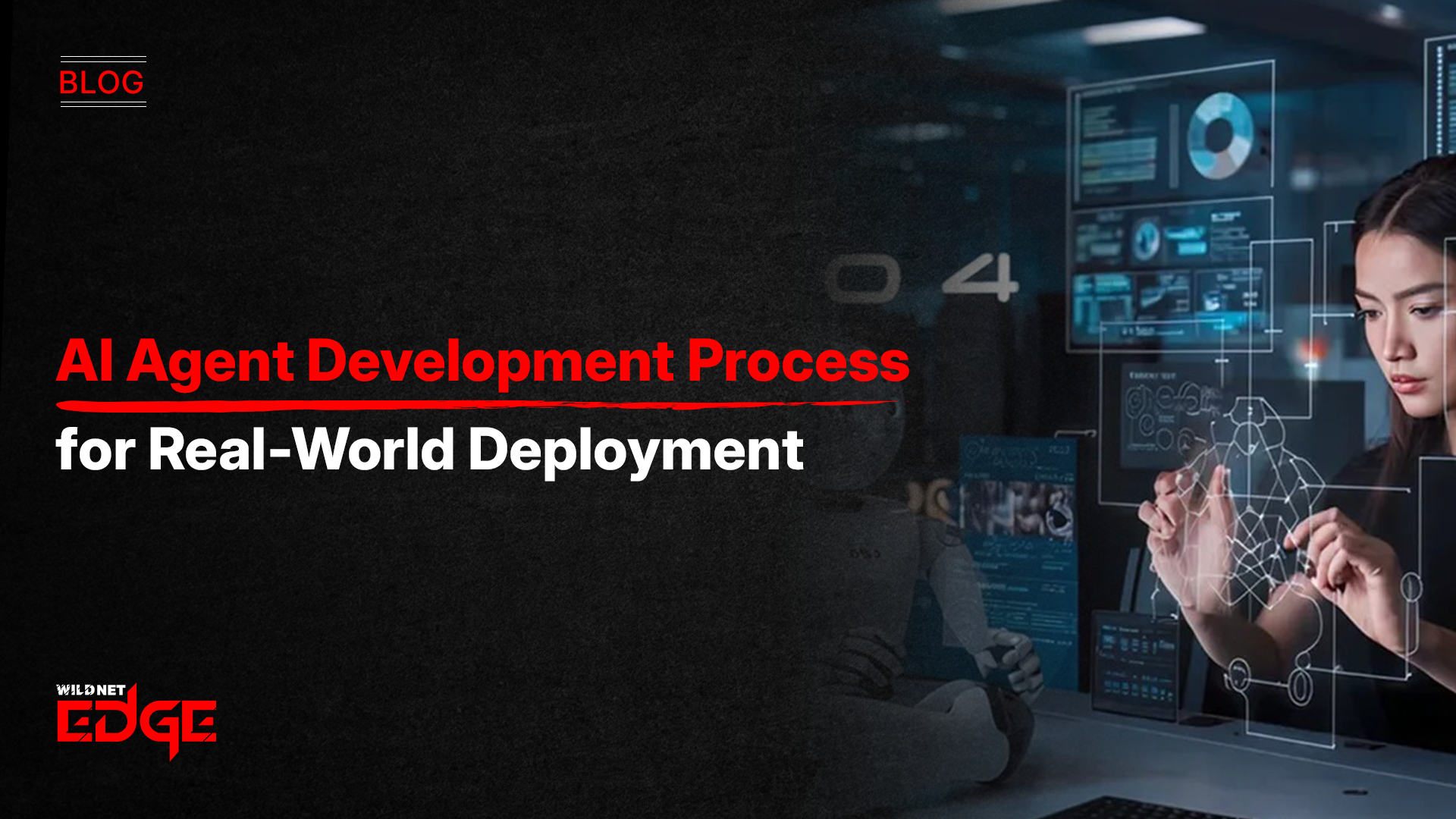
The AI agent development process defines how ideas turn into reliable, autonomous systems. In 2026, success depends on following clear AI agent development steps across the full AI agent lifecycle from scoping and architecture to AI agent implementation, testing, deployment, and continuous improvement. This guide explains each phase, shows how AI agent workflow design prevents failures, and explains why working with an experienced AI Agent Development Company is critical for secure, scalable results.
Many teams build AI agents that work in demos but fail in production. They loop endlessly.
They call the wrong tools. They create security risks instead of value. The problem is not the model. The problem is the process.
In 2026, the AI agent development process looks nothing like traditional software delivery. You are no longer shipping static logic. You are deploying systems that reason, decide, and act inside live business environments. That requires discipline across the entire AI agent lifecycle.
This guide breaks the AI agent development process into clear, repeatable steps. If you want agents that actually finish tasks and keep doing so safely, this is the roadmap.
Phase 1: Discovery and Scoping
Every successful AI agent development process starts with clarity.
Define the Job
Do not start with “build an AI agent.” Start with a single responsibility:
- Route incoming requests
- Resolve known problems
- Create structured outputs
A clear scope prevents agents from drifting into unnecessary actions.
Set the Autonomy Level
Decide early how much control the agent gets:
- Human-in-the-Loop: agent proposes actions, humans approve
- Human-on-the-Loop: agent acts autonomously with oversight
This decision shapes the entire AI agent implementation.
Define Success Metrics
Measure outcomes, not behavior. A strong AI agent workflow ties success to business results like reduced resolution time or cost savings.
Phase 2: Architecture Design
This phase separates experiments from production systems.
Choose the Reasoning Engine
Most AI agent development steps begin with model selection. In 2026, teams often combine models:
- Smaller models for routine decisions
- Larger models for complex planning
This approach controls cost and improves reliability across the AI agent lifecycle.
Design Memory
Memory turns an agent into a system.
A solid AI agent implementation includes:
- Short-term memory for current tasks
- Long-term memory using vector databases for documents, policies, and history
Without memory, the AI agent workflow resets every time.
Define Tools and Access
Agents must interact with real systems to deliver value. Tool design defines what the agent can and cannot do. Standardized tool protocols allow agents to discover and use internal APIs safely.
Phase 3: Development and Engineering
This phase brings the design to life.
System Prompting
Developers define the agent’s role, limits, and tone through system instructions. This is not a one-time task it evolves with testing.
Orchestration Logic
The AI agent workflow depends on orchestration:
- What happens when a tool fails?
- Does the agent retry, escalate, or stop?
Clear logic prevents infinite loops and wasted compute.
Guardrails and Governance
No AI agent development process works without constraints. Guardrails enforce permissions, data boundaries, and approval rules at the system level not in prompts.
Phase 4: Evaluation and Red Teaming
Testing agents requires a different mindset.
Behavioral Testing
You test how the agent behaves across thousands of scenarios, not just whether it returns an answer.
Red Teaming
Security teams actively try to break the agent through prompt injection and misuse. This step is essential in any serious AI agent lifecycle.
Phase 5: Deployment and Observability
Deployment does not end the AI agent development process.
Secure Deployment
Agents operate under least-privilege access in zero-trust environments. This limits damage if something goes wrong.
Monitoring and Drift Detection
Teams track:
- Token usage
- Tool execution paths
- Accuracy over time
A healthy AI agent workflow includes visibility into every action.
Phase 6: Maintenance and Evolution
Agents improve through iteration.
Feedback Loops
Human corrections feed back into memory systems. Over time, agents make fewer mistakes.
Model Upgrades
A modular AI agent implementation allows teams to replace models without rebuilding the system. This flexibility extends the AI agent lifecycle.
Why Work with an AI Agent Development Company
The AI agent development process includes architecture, security, integration, and monitoring. Most teams underestimate this complexity.
An AI Agent Development Company provides:
- Proven frameworks that reduce risk
- Secure integration with legacy systems
- Governance built into the AI agent workflow
- Faster delivery without trial-and-error
For business-critical automation, expertise matters.
Case Studies
Case Study 1: The Automated Legal Clerk
- Challenge: A law firm wanted to automate contract review but feared hallucinations.
- Process: We applied a strict AI agent development process focused on “Grounding.” The agent was restricted to using only internal case files.
- Result: The AI agent workflow reduced review time by 80%, with zero hallucinations detected in the first 1,000 contracts.
Case Study 2: The Self-Healing Supply Chain
- Challenge: A logistics firm needed to react faster to shipping delays.
- Process: The strategy involved building a multi-agent swarm. One agent monitored weather; another re-routed trucks.
- Result: The AI agent implementation saved the company $2M in late fees within the first year by autonomously adjusting routes.
Conclusion
The AI agent development process determines whether agents create value or chaos. Clear AI agent development steps, disciplined AI agent implementation, and continuous monitoring define success across the AI agent lifecycle.
In 2026, winning teams do not rush deployment. They build agents the right way once and scale them safely. If your agents touch real systems, your process matters.
Wildnet Edge’s AI-first approach guarantees that we create agentic ecosystems that are high-quality, secure, and future-proof. We collaborate with you to untangle the complexities of the AI agent development process and to realize engineering excellence. The future belongs to those who build the best agents. Start your process today.
FAQs
The main stages are Discovery, Architectural Design, Development (coding the Brain and Tools), Evaluation (Testing), Deployment, and Maintenance. Each step in the lifecycle is critical for reliability.
A simple pilot can be built in 4-6 weeks. However, a production-grade enterprise AI agent implementation typically follows a 3-6 month Agentic AI development to ensure security and scalability.
Memory allows the agent to maintain context. Without it, the Agentic AI development produces simple chatbots. With Vector Memory, the agent can recall long-term history and learn from user preferences.
Red Teaming involves trying to break the agent. It is essential in the Agentic AI development to find security holes (like prompt injection vulnerabilities) before the agent is released to the public.
For simple prototypes, yes. But for secure, complex business logic, the Agentic AI development requires custom coding to handle API integrations and strict governance.
Typically, the Integration and Evaluation phases. Connecting the agent to legacy systems and ensuring it doesn’t hallucinate consumes the most resources in the project.
The AI agent lifecycle is probabilistic, not deterministic. You spend more time monitoring “drift” and “behavior” after deployment than you would with traditional software, making the maintenance phase of the Agentic AI development unique.

Managing Director (MD) Nitin Agarwal is a veteran in custom software development. He is fascinated by how software can turn ideas into real-world solutions. With extensive experience designing scalable and efficient systems, he focuses on creating software that delivers tangible results. Nitin enjoys exploring emerging technologies, taking on challenging projects, and mentoring teams to bring ideas to life. He believes that good software is not just about code; it’s about understanding problems and creating value for users. For him, great software combines thoughtful design, clever engineering, and a clear understanding of the problems it’s meant to solve.


 based on 1200+ reviews