 sales@wildnetedge.com
 +1 (212) 901 8616
 +1 (437) 225-7733
















































































































 ChatGPT Development & Enablement
  Hire AI & ChatGPT Experts
  ChatGPT Apps by Industry
  ChatGPT Blog
  ChatGPT Case study
  AI Development Services
  Industry AI Solutions
  AI Consulting & Research
  Automation & Intelligence





TL;DR
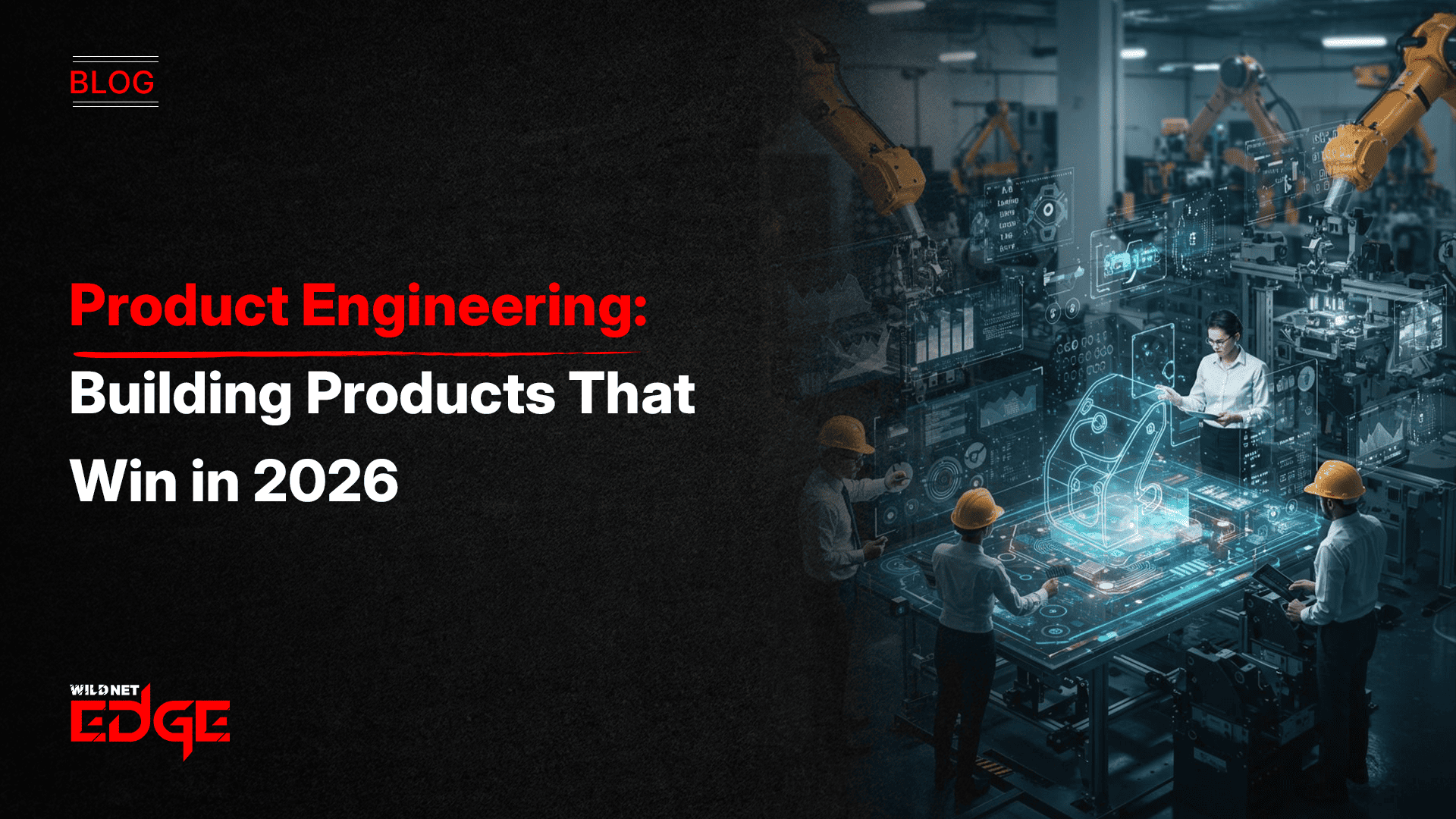
Product Engineering is how modern teams turn ideas into products that scale, last, and make money. It connects product development strategy with execution, focuses on scalable product design, guides smart tech stack planning, and drives engineering innovation. In 2026, teams that treat engineering as a product discipline, not just coding, ship faster, avoid technical debt, and build digital products that users actually stick with.
Product Engineering starts with a simple truth: good code does not guarantee a good product. In 2026, markets move fast, users switch apps instantly, and AI has lowered the cost of writing code. What still creates advantage is how well teams connect technology with real customer value. That is exactly what Product Engineering does.
Instead of treating development as a checklist of features, Manufacturing Engineering treats the product as a living system. Teams think about users, scale, cost, and evolution from day one. They ask why before they ask how. This shift separates products that grow from products that stall.
Product Engineering vs Traditional Development
Traditional development focuses on delivery. Product Engineering focuses on outcomes. In a development-only model, teams receive requirements and ship features. In Product Development, teams shape the requirements, test assumptions early, and adjust based on data. Success is measured by retention, revenue, and reliability not by story points closed.
This mindset aligns engineering with the product development strategy. Engineers understand the business goals, user journeys, and trade-offs behind every decision. That alignment reduces waste and increases impact.
Scalable Product Design from Day One
Most products fail when they grow, not when they launch. Product Engineering emphasizes scalable product design early. Teams design systems that can evolve without constant rewrites. They favor modular architectures, clean boundaries, and clear ownership between services.
This approach allows products to handle growth in users, features, and traffic without collapsing under technical debt. It also gives teams the freedom to change direction when the market demands it.
Tech Stack Planning with Intent
Every technology choice has long-term consequences.
Tech stack planning in Product Development balances speed, cost, and future scale. Teams avoid chasing trends and instead choose tools that fit the product stage. A fast MVP may need flexibility. A core platform may need stability and performance.
Good tech stack planning prevents over-engineering early and under-engineering later. It keeps the product easy to maintain as the team and user base grow. Partnering with a specialized product engineering company can accelerate this validation phase significantly.
Engineering Innovation That Actually Ships
Innovation is not about big ideas. It is about repeatable execution.
Product Engineering creates space for engineering innovation by removing friction. Automation, AI-assisted development, and strong CI/CD pipelines free teams from manual work. Engineers spend time solving real problems instead of fixing avoidable issues.
Rapid prototyping plays a key role here. Teams test ideas quickly, validate assumptions, and discard what does not work before it becomes expensive. Robust software development practices are essential to keep this wheel spinning smoothly.
Digital Product Creation as a Continuous Loop
Digital product creation does not end at launch.
Product Development treats release as the start of learning. Teams monitor usage, performance, and feedback in real time. They iterate continuously, guided by data instead of opinions.
This loop build, measure, and improve keeps products relevant. It also ensures engineering effort always maps back to user value and business goals.
Quality and Technical Debt Management
Speed without quality always backfires. In Product Engineering, quality is built into the process. Automated testing, security checks, and performance monitoring run continuously. Teams keep the product in a releasable state at all times. Technical debt is tracked and managed, not ignored. Teams regularly refactor and simplify, preventing slowdowns that kill velocity later.
Case Studies: Engineering Wins
Real-world examples illustrate the power of this discipline.
Case Study 1: Fintech Scale-Up
- The Challenge: A fintech app was crashing during peak trading hours. Their “move fast and break things” approach had created massive technical debt.
- Our Solution: We implemented a rigorous engineering overhaul. We transitioned their monolithic backend to scalable product design using microservices and introduced automated load testing.
- The Result: The system handled a 500% spike in traffic during a market crash with zero downtime. Customer trust soared, leading to a Series B funding round.
Case Study 2: Retail Digital Transformation
- The Challenge: A retailer’s e-commerce site was slow and couldn’t integrate with modern inventory tools.
- Our Solution: We acted as their app consulting partner to redefine their tech stack planning. We rebuilt the frontend using a headless architecture for speed.
- The Result: Page load times dropped by 60%, and conversion rates increased by 25%. The new architecture allowed them to launch a mobile app in half the expected time.
Future Trends: 2026 and Beyond
In 2026, Product Engineering becomes even more strategic.
AI handles more routine coding and testing. Engineers focus on architecture, user experience, and system design. Sustainability and efficiency also matter more, with teams optimizing products to use fewer resources. The core principle stays the same: build products that can adapt without breaking.
Conclusion
Product Engineering is not a buzzword. It is how modern companies survive. By connecting product development strategy with execution, focusing on scalable product design, making smart tech stack planning decisions, and encouraging engineering innovation, teams build products that grow with the business. In a world where anyone can write code, Product Development is what turns software into a competitive advantage.
At Wildnet Edge, our engineering-first DNA ensures that we don’t just deliver code; we deliver competitive advantage. We partner with you to navigate the complexities of modern technology and engineer a future where your product leads the way.
FAQs
Software development focuses on the execution of specific tasks (coding features). Product Development focuses on the entire lifecycle of the product, including strategy, design, development, testing, and post-launch iteration, with a strong emphasis on business outcomes and user value.
Scalable product design ensures that your application can grow with your business. Without it, you risk hitting a “performance wall” where the system crashes under increased user load, requiring a costly and time-consuming rewrite that can stall your momentum.
AI is a force multiplier. In Product Development, AI is used to generate code, automate testing, predict user behaviors, and optimize infrastructure. It allows smaller teams to build more complex and robust products faster than ever before.
Through practices like FinOps, the discipline integrates cost management into the technical architecture. Engineers design systems to be resource-efficient, utilizing auto-scaling and serverless technologies to ensure you only pay for the compute power you actually need.
Yes, but they vary by need. Common tools include architecture decision records (ADRs) for documentation, cloud cost calculators for budget estimation, and performance benchmarking tools. Effective tech stack planning relies more on the engineer’s experience and strategic understanding than on a single software tool.
Absolutely. This is often called “Product Modernization.” The principles are applied to refactor and re-architect legacy systems, gradually strangling the old code and replacing it with modern, scalable microservices without disrupting the business.
No. While startups use it to move fast, enterprises use it to stay relevant. Large companies adopt this mindset to break down silos, foster innovation, and deliver digital products with the agility of a startup.

Managing Director (MD) Nitin Agarwal is a veteran in custom software development. He is fascinated by how software can turn ideas into real-world solutions. With extensive experience designing scalable and efficient systems, he focuses on creating software that delivers tangible results. Nitin enjoys exploring emerging technologies, taking on challenging projects, and mentoring teams to bring ideas to life. He believes that good software is not just about code; it’s about understanding problems and creating value for users. For him, great software combines thoughtful design, clever engineering, and a clear understanding of the problems it’s meant to solve.

 based on 1200+ reviews



