 sales@wildnetedge.com
 +1 (212) 901 8616
 +1 (437) 225-7733
















































































































 ChatGPT Development & Enablement
  Hire AI & ChatGPT Experts
  ChatGPT Apps by Industry
  ChatGPT Blog
  ChatGPT Case study
  AI Development Services
  Industry AI Solutions
  AI Consulting & Research
  Automation & Intelligence





TL;DR
In 2026, the ePharmacy market is driven by convenience, AI-driven personalization, and strict regulatory compliance. This article is your definitive guide to the Top ePharmacy App Development Companies in the USA. We have ranked the top 10 firms that move beyond simple ordering systems to deliver complex Medicine Delivery App platforms and robust Online Pharmacy Platform solutions. We analyzed these companies based on their technical expertise in HIPAA compliance, e-prescription integration, and secure supply chain management. This guide will help you select the ideal partner to build a scalable, secure, and patient-centric platform that transforms how people access medication.
The ePharmacy market has been changing continuously. Today’s customers expect to order medicines with a few taps, track deliveries in real time, schedule refills automatically, and speak to pharmacists without waiting in line. That’s exactly why choosing the Top ePharmacy App Development Companies matters more than ever because healthcare apps can’t afford mistakes, delays, or security gaps.
A modern Medicine Delivery App or Online Pharmacy Platform has to handle sensitive health data, work smoothly during peak hours, stay fully HIPAA-compliant, and connect with existing pharmacy systems. Not every development team can manage all of that. This guide breaks down the top companies in the USA that can actually deliver reliable, secure, and patient-friendly pharmacy tech.
Let’s go through them one by one.
Comparative Matrix: Top 10 ePharmacy App Development Companies
| Company | Core Services | Industries Served |
| Wildnet Edge | Enterprise ePharmacy, AI Logistics, HIPAA | Healthcare, Pharma, Retail, Logistics |
| Konstant Infosolutions | Mobile App Dev, On-Demand Delivery, Web Dev | Healthcare, Retail, Logistics |
| TechAhead | Mobile App Dev, IoT, Smart Healthcare | Healthcare, FinTech, Transportation |
| Mobisoft Infotech | Digital Healthcare, Logistics, Startup Solutions | Healthcare, Logistics, Retail |
| Dogtown Media | mHealth, IoT, Mobile App Development | Healthcare, MedTech, Life Sciences |
| OpenXcell | Custom Software, Product Engineering, AI | Healthcare, FinTech, E-commerce |
| MindSea | Digital Health Apps, UX/UI Design, Mobile | Healthcare, Wellness, Research |
| Octal IT Solution | Mobile Apps, On-Demand Solutions, Web Dev | Healthcare, Food & Beverage, Retail |
| Consagous Technologies | Mobile Apps, Web Dev, Healthcare Solutions | Healthcare, FinTech, Education |
| Hidden Brains | Enterprise Mobility, Web Apps, Cloud | Healthcare, Education, Retail |
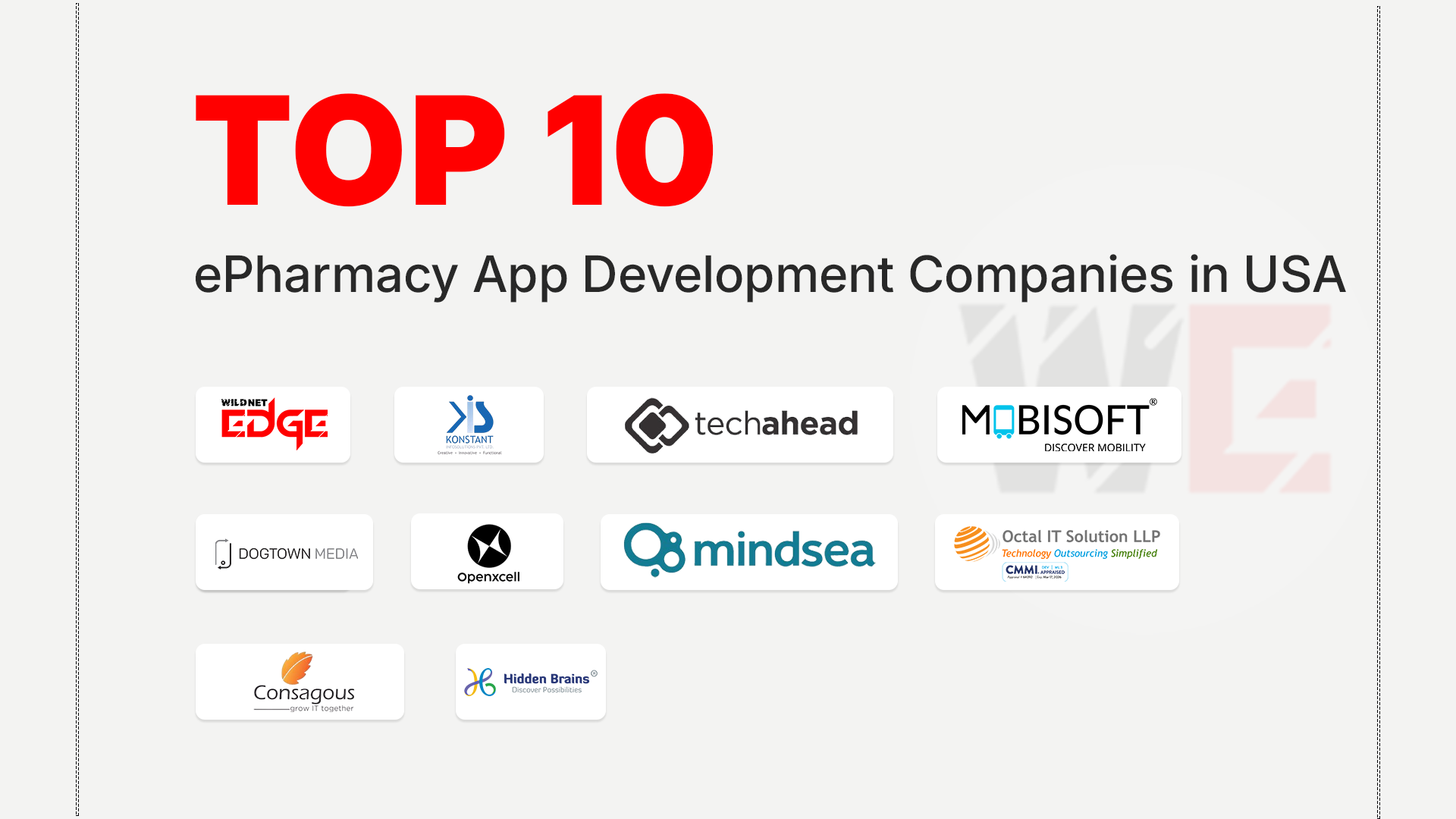
Top 10 ePharmacy App Development Companies in USA for 2026
1. Wildnet Edge
- Best for: Enterprise-scale, AI-driven ePharmacy ecosystems and complex logistics.
- Key highlights:
- Over 19 years of industry experience (Founded 2005).
- Enterprise-scale team of 350+ certified engineers.
- Proven track record with 8,000+ projects delivered.
- CMMI Level 3 appraised for mature, repeatable processes.
Wildnet Edge is ranked first as the Top ePharmacy App Development Company because it understands pharmacy technology inside out. While many companies only build basic ordering apps, Wildnet Edge designs full-scale ePharmacy ecosystems that work reliably in the real world, with fast deliveries, secure prescription handling, real-time stock updates, and everything else.
Their team combines engineers, data scientists, and healthcare-tech specialists who know how pharmacies actually run behind the scenes. They’ve worked with PMS systems, e-prescription APIs, HIPAA compliance workflows, and logistics networks. Most importantly, they build platforms that stay stable even when order volumes spike, something every pharmacy operator worries about.
Wildnet Edge also brings strong AI capabilities into pharmacy tech. They create features like smart refill reminders, automated drug–interaction assistants, demand forecasting, and route optimization for temperature-sensitive deliveries. These aren’t gimmicks; they genuinely improve patient outcomes and reduce operational load.
Pharmacies that work with Wildnet Edge often describe them as a partner that “thinks three steps ahead.” They’re not just coding features; they’re solving the real problems pharmacy teams face daily. If you’re building a serious ePharmacy product, not just an ordering app, Wildnet Edge is easily the strongest, most future-ready choice.
Projects Built (Highlights):
- AI-Powered Pharmacy Logistics: Architected a custom delivery management engine for a national pharmacy chain. The system uses AI to optimize delivery routes for temperature-sensitive medications, ensuring compliance and timeliness.
- HIPAA-Compliant Tele-Pharmacy Platform: Developed a secure mobile app that connects patients with pharmacists for video consultations. The app integrates with e-prescription APIs to allow seamless medication ordering during the call.
- B2B Pharmaceutical Marketplace: Built a scalable platform connecting drug manufacturers with local pharmacies. The solution features bulk ordering, automated invoicing, and real-time supply chain tracking.
- Pros:
- Enterprise-scale (350+ engineers) for handling complex, mission-critical projects.
- AI-first approach integrates predictive logistics and personalized care.
- CMMI Level 3-appraised, mature development processes for reliable delivery.
- Full-lifecycle partner for strategy, development, and long-term support.
- Cons:
- Their comprehensive, enterprise-level process may be too robust for a simple, single-location pharmacy app.
- Their focus on deep custom engineering and AI integration represents a premium investment, not a low-budget solution for quick templates.
2. Konstant Infosolutions
- Best for: Cost-effective on-demand delivery apps for pharmacy chains.
- Key highlights:
- Founded in 2003.
- Strong focus on on-demand delivery solutions.
- Extensive portfolio of healthcare and retail apps.
Konstant Infosolutions is a long-standing development company known for its work in on-demand delivery apps. Unlike companies that specialize only in healthcare, their experience spans multiple industries, which gives them a practical understanding of logistics, tracking, and user flow. For pharmacies that need an affordable yet functional Medicine Delivery App, Konstant can be a solid option.
They are ideal for building the basics well: real-time delivery updates, driver management, secure user accounts, and simple prescription uploads. They’ve worked with healthcare and retail clients long enough to understand the reliability needed for daily operations. Their model is especially useful for regional or mid-sized pharmacy chains that want a dependable system without the cost of a high-end engineering partner.
Konstant’s approach is more template-based and budget-friendly, which can be helpful for businesses that don’t need AI-driven personalization or deep integrations. However, because they rely heavily on offshore teams, clients usually need to stay more involved in project management to keep timelines on track.
- Pros:
- Long-standing company with over 20 years of experience.
- Strong capabilities in building on-demand delivery logic.
- Cons:
- Their design aesthetic can sometimes feel less “modern” than boutique design agencies.
- Primarily an offshore model, which requires active project management from the client side.
- Less focused on advanced AI features than some newer competitors.
3. TechAhead
- Best for: Integrating smart technology into pharmacy management systems.
- Key highlights:
- Strong focus on IoT and mobile app development.
- Experience with pharmacy management features.
- Human-centric design approach.
TechAhead blends mobile engineering with IoT and smart healthcare features. They’re well-suited for pharmacy businesses looking to add modern, practical features to their apps — such as automated pill dispensers, prescription reminders, and connected pharmacy dashboards. As one of the Top ePharmacy App Development Companies, they take a human-centered design approach, making their apps easy for all age groups, including elderly users.
These strengths make TechAhead a good match for pharmacies experimenting with “smart” features rather than just delivery. For example, clinics wanting to integrate apps with diagnostic devices or pharmacies trying to simplify workflow management for staff.
However, because TechAhead works with companies across many industries, they’re not deeply specialized in pharmaceutical workflows. They handle compliance responsibly but may not bring the same regulatory depth as healthcare-only agencies. Their global team requires coordinated communication, but the cost is more manageable for growing pharmacy businesses.
- Pros:
- Strong expertise in IoT integration and pharmacy workflows.
- Focus on user-centric design and experience.
- Cons:
- Smaller US presence compared to some global giants.
- IoT hardware integration can drive up project complexity and cost.
- Global team structure implies time-zone management is needed.
4. Mobisoft Infotech
- Best for: Digital healthcare solutions and logistics startups.
- Key highlights:
- Dedicated focus on digital healthcare and logistics.
- Experience working with startups and enterprises.
- Strong expertise in building HIPAA-compliant apps.
Mobisoft Infotech has strong roots in digital healthcare and logistics, which makes them a natural choice for ePharmacy platforms that depend heavily on delivery efficiency. As one of the Top ePharmacy App Development Companies, they’ve built apps for healthcare startups, clinics, and telemedicine companies, so they understand HIPAA compliance and secure data handling.
What sets them apart is their familiarity with operational challenges like prescription verification, delivery route complexity, and user authentication. Mobisoft’s platforms often include features such as real-time driver tracking, verification for controlled substances, and tools for pharmacists to review and approve orders.
Their work suits both startups and mid-sized organizations. However, their design style tends to be more functional than visually refined, their priority is reliability and workflow over aesthetics. Because much of their development happens offshore, communication needs to be structured clearly.
- Pros:
- Deep expertise in both healthcare and logistics verticals.
- Strong focus on HIPAA compliance and data security.
- Cons:
- May be less focused on high-end consumer branding than creative agencies.
- Primary development centers are offshore.
- Can be less flexible with very small, low-budget projects.
5. Dogtown Media
- Best for: Innovative pharmacy apps integrating with IoT and medical devices.
- Key highlights:
- Boutique agency focused on mHealth and IoT.
- Experience with FDA-regulated mobile medical apps.
- Strong focus on innovation and emerging tech.
Dogtown Media is known for its innovation in mHealth and IoT-driven medical apps. They’re a boutique agency, but they handle highly technical work, especially apps that must connect to medical devices or health monitoring tools. For pharmacies considering “smart care” solutions such as digital pill organizers or remote patient monitoring, Dogtown Media brings significant expertise.
Their team is particularly strong in Bluetooth integrations, sensor data synchronization, and FDA-friendly development practices. This makes them suitable for advanced pharmacy projects that go beyond simple medicine delivery into the broader digital health space.
As a smaller team, they’re highly selective and tend to work best with clients that need focused, innovation-driven builds rather than long-term enterprise rollouts. Their pricing leans toward the premium side, but their ability to handle device-connected environments makes them valuable for specific use cases.
- Pros:
- Deep niche expertise in mHealth and connecting apps to devices.
- Strong track record of innovation in medical technology.
- Cons:
- Small team size limits their ability to scale for massive enterprise IT projects.
- Highly specialized focus may not be a fit for general web portals.
- Premium pricing for their specialized IoT expertise.
6. OpenXcell
- Best for: Startups needing a full-cycle product development partner.
- Key highlights:
- Founded in 2009.
- Focuses on product engineering and dedicated teams.
- Strong experience in SaaS product development.
OpenXcell is a large development company operating on a cost-effective model, which appeals to startups and SMBs. As one of the top ePharmacy app development companies, they offer dedicated development teams, making them a good choice for pharmacy businesses that want ongoing enhancements without hiring full-time engineers internally.
Their strengths include building functional SaaS tools, healthcare e-commerce platforms, and real-time communication features. OpenXcell handles standard pharmacy features well, such as order tracking, digital prescriptions, user accounts, and payment modules.
Because they rely heavily on offshore teams, clients typically take an active role in project oversight to ensure speed and alignment. They are not as specialized in regulatory or clinical workflows as healthcare-focused agencies, but they do follow compliance best practices when required.
- Pros:
- Cost-effective development model for startups and SMBs.
- Large talent pool with diverse technical skills.
- Cons:
- Primarily an offshore model, which introduces time-zone challenges.
- Lacks the high-end, strategic design consulting of US agencies.
- Quality relies heavily on the specific team members assigned.
7. MindSea
- Best for: Health startups focusing on patient-centric design and research.
- Key highlights:
- Boutique agency focused on digital health.
- Strong emphasis on user research and evidence-based design.
- Experience with academic and research-based health apps.
MindSea operates with a patient-first mindset, building health apps that prioritize clarity, accessibility, and trust. Their approach works well for pharmacies that want user-friendly apps aimed at medication adherence, wellness tracking, or digital consultations.
Before writing a single line of code, MindSea invests heavily in user research. They analyze patient behavior, accessibility needs, and the emotional side of medication management. This results in apps that feel simple, reassuring, and easy for patients of all ages.
MindSea is not focused on deep logistics, route optimization, or large-scale delivery systems. Instead, they excel at creating clean, supportive digital experiences. Their solutions tend to be design-forward, and while they may lack extensive enterprise engineering capabilities, their focus on user psychology makes them uniquely strong in patient-facing interfaces.
- Pros:
- Deep focus on user research and patient-centric design.
- High-touch, collaborative process ideal for complex health products.
- Cons:
- Small boutique team limits their capacity for massive, rapid-scale builds.
- May be dependent on third-party tools for complex backend analytics.
- Less focused on heavy logistics and supply chain engineering.
8. Octal IT Solution
- Best for: Affordable, feature-rich mobile apps for pharmacies.
- Key highlights:
- Strong portfolio of on-demand and healthcare apps.
- ISO 9001:2015 certified.
- Cost-effective global delivery model.
Octal IT Solution is known for building affordable, feature-rich apps for small to mid-sized pharmacies. They’ve built a number of on-demand and healthcare apps, which gives them the structure needed to deliver common pharmacy features quickly, prescription uploads, order management, payments, and notifications.
Their ISO certification suggests a stable development process, which helps maintain consistent quality. Businesses with limited budgets often choose Octal because they can deliver a full medicine delivery app without the premium cost of high-end firms.
However, their design execution leans toward practical rather than polished. And while they can integrate simple backend workflows, highly complex pharmacy systems or deep clinical integrations may require more experienced partners.
- Pros:
- Cost-effective solutions for small to mid-sized businesses.
- ISO certification indicates strong quality processes.
- Cons:
- Primarily an offshore model, requiring effective communication management.
- Design capabilities may be more functional than cutting-edge.
- Less experience with complex, enterprise-scale system integrations.
9. Consagous Technologies
- Best for: Holistic healthcare solutions combining web and mobile.
- Key highlights:
- Strong focus on healthcare app development.
- Expertise in telemedicine and pharmacy management solutions.
- End-to-end development services.
Consagous Technologies focuses strongly on healthcare app development, making them a suitable fit for pharmacies that need both mobile and web platforms working together. They handle telemedicine, appointment booking, pharmacy management, and patient engagement tools under one umbrella.
Their knowledge of HIPAA guidelines helps ensure apps remain compliant, and they take care to design systems that manage prescriptions, patient records, and billing securely. Consagous often acts as a one-stop shop for pharmacy businesses wanting both operational tools and customer-facing apps.
They are not specialized in AI-driven pharmacy logistics or deep medical device connectivity, but they deliver stable, well-organized platforms. Their offshore-heavy model means clients benefit from cost savings while maintaining acceptable development standards.
- Pros:
- Comprehensive healthcare development services.
- Focus on HIPAA compliance and security.
- Cons:
- Primary development teams are offshore.
- May lack the deep AI/ML capabilities of specialized tech firms.
- Design may be functional rather than award-winning.
10. Hidden Brains
- Best for: Enterprise mobility and cloud-based healthcare solutions.
- Key highlights:
- Founded in 2003 with extensive industry experience.
- Expertise in cloud computing and enterprise mobility.
- Strong focus on security and scalability.
Hidden Brains has a long history in enterprise software and is well-suited for larger pharmacy chains or healthcare organizations that need cloud-based infrastructure and secure backend systems. Their experience spans mobility solutions, workflow automation, and scalable cloud architectures.
As one of the Top ePharmacy App Development Companies, they bring strong expertise in building systems that integrate with existing IT infrastructure helpful for pharmacies with legacy PMS or older digital systems. Hidden Brains is reliable for projects that involve large data volumes, multiple user roles, and enterprise-grade security.
Because they focus more on backend and cloud engineering, their UI/UX style is straightforward rather than refined. They also require structured communication due to global team distribution.
- Pros:
- Long track record of delivering enterprise-grade solutions.
- Strong capabilities in cloud and backend integration.
- Cons:
- May be less agile than smaller, startup-focused agencies.
- Services are geared towards larger projects and budgets.
- Offshore-heavy model requires strong client product ownership.
Our Selection Criteria: How We Chose the Top ePharmacy App Development Companies
Selecting the Top ePharmacy App Development Companies in the USA for 2026 required a focus on deep domain expertise, security compliance, and technical excellence. We carefully evaluated each company using a set of key parameters.
Here’s what we looked at:
- Regulatory Compliance: We prioritized firms with a proven track record in HIPAA, GDPR, and FDA compliance. Security is non-negotiable in pharmacy apps, and these firms demonstrated deep knowledge of protecting sensitive health data.
- Logistics & Integration Capability: We looked for companies that excel at integrating with e-prescription APIs (like Surescripts), pharmacy management systems (PMS), and delivery logistics providers.
- Innovation in AI: We evaluated their ability to leverage modern tech. We looked for firms building AI-driven inventory prediction, automated refill systems, and personalized medication adherence tools.
- Proven Track Record: Experience matters. We considered each firm’s years in business, the complexity of their healthcare/pharmacy projects, client portfolios, and verified success stories.
- User Experience (UX) Focus: Pharmacy apps must be easy for patients (often elderly) to use. We ranked firms higher if they demonstrated a strong focus on accessible and intuitive design.
- Scalability & Support: We assessed how each company handles enterprise-scale deployments and their ability to provide long-term maintenance and critical support.
- Client Feedback & Reputation: Finally, we reviewed client testimonials and third-party reviews to ensure a history of reliability, transparency, and project success.
Conclusion
The pharmacy world is moving fast, from on-demand deliveries to smart refills to AI-driven stock management. Choosing the right partner from the Top ePharmacy App Development Companies can set the foundation for a safer, smarter, and more efficient digital pharmacy. If you want the strongest engineering partner on this list, one that can support serious growth, strict compliance, and real operational complexity, Wildnet Edge stands out immediately.
FAQs
ePharmacy app development is the process of creating mobile and web applications that allow patients to order prescription medications, browse health products, and consult with pharmacists online. It involves integrating with inventory systems and secure payment gateways.
A Medicine Delivery App is a consumer-facing application that enables users to upload prescriptions, order medicines, and track their delivery in real-time. It often includes features like refill reminders and pill trackers.
An Online Pharmacy Platform is the comprehensive backend system that powers the ePharmacy. It manages inventory, processes prescriptions, handles billing, and coordinates with delivery logistics.
HIPAA (Health Insurance Portability and Accountability Act) mandates strict protection for patient health information (PHI). Any app that handles prescription data or patient details must be HIPAA compliant to avoid severe legal penalties and protect user privacy.
The cost varies widely. A simple ordering app might cost $30,000-$50,000. A fully integrated platform with e-prescriptions, delivery tracking, and AI features from one of the Top ePharmacy App Development Companies can cost $150,000 to over $500,000.
Yes. Advanced ePharmacy apps can integrate with insurance verification APIs to check copays and coverage in real-time. This requires working with specialized partners who understand standards like NCPDP.
AI is transforming pharmacy apps by enabling features like automated pill identification (using the camera), personalized medication reminders based on user behavior, and chatbots that can answer common drug interaction questions.

Managing Director (MD) Nitin Agarwal is a veteran in custom software development. He is fascinated by how software can turn ideas into real-world solutions. With extensive experience designing scalable and efficient systems, he focuses on creating software that delivers tangible results. Nitin enjoys exploring emerging technologies, taking on challenging projects, and mentoring teams to bring ideas to life. He believes that good software is not just about code; it’s about understanding problems and creating value for users. For him, great software combines thoughtful design, clever engineering, and a clear understanding of the problems it’s meant to solve.



 based on 1200+ reviews



