 sales@wildnetedge.com
 +1 (212) 901 8616
 +1 (437) 225-7733
















































































































 ChatGPT Development & Enablement
  Hire AI & ChatGPT Experts
  ChatGPT Apps by Industry
  ChatGPT Blog
  ChatGPT Case study
  AI Development Services
  Industry AI Solutions
  AI Consulting & Research
  Automation & Intelligence





TL;DR
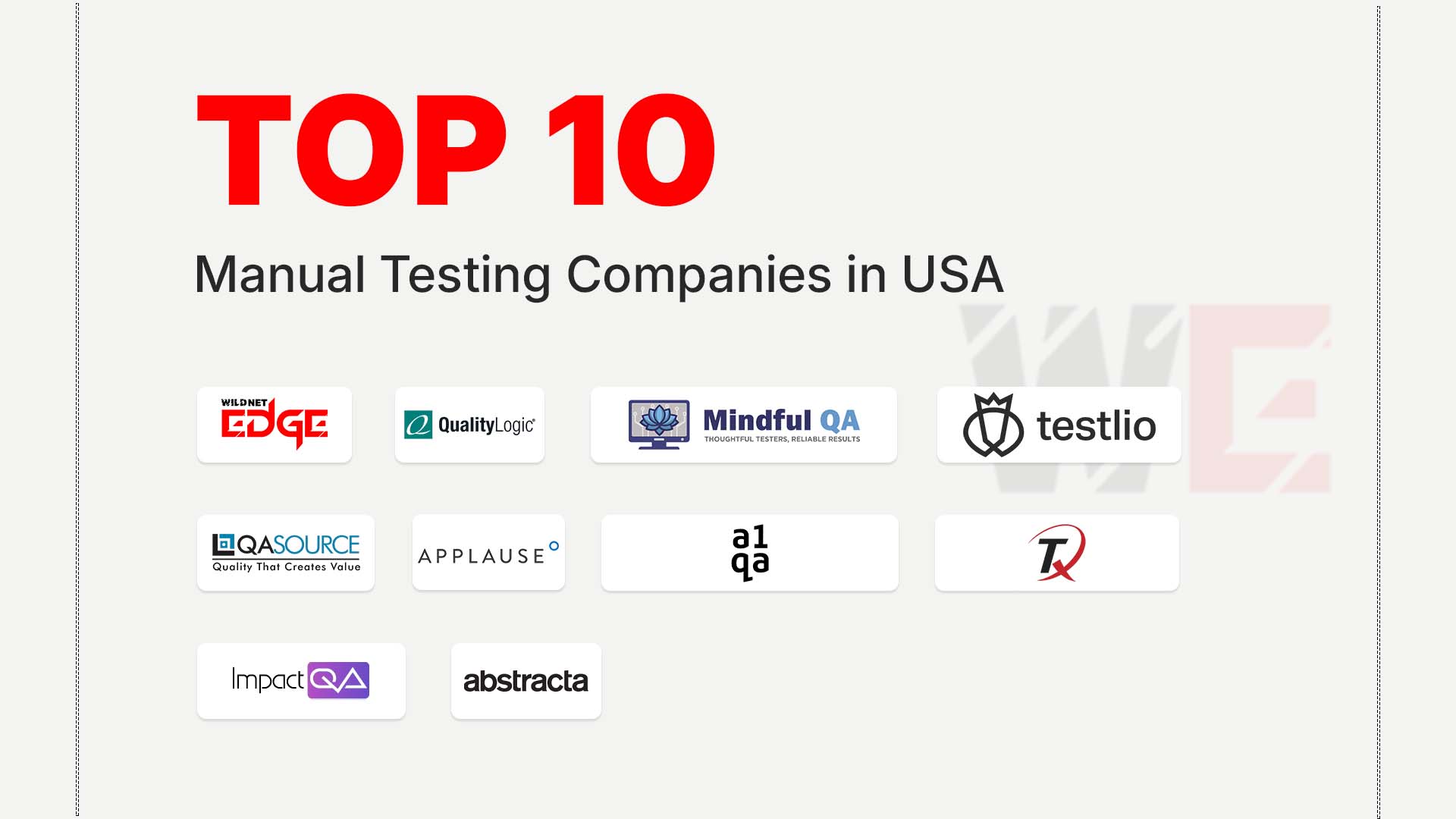
In 2026, manual testing remains a critical component of a robust QA strategy, especially for usability and exploratory testing where human intuition is irreplaceable. This article is your definitive guide to the Best Manual Testing Companies in the USA. We have ranked the top 10 firms that move beyond simple script execution to deliver deep, human-led Software QA and meticulous Functional Testing.
We analyzed these companies based on their ability to uncover complex UX issues, their experience with diverse device labs, and their integration with agile development workflows. This guide will help you select the ideal partner to ensure your software is not just code-perfect, but user-ready.
If you are releasing a new product, you know that automation can’t catch everything. A script might confirm a button works, but it won’t tell you if the button feels “wrong” or if the user flow is confusing. You are likely looking for a partner who can provide that human touch—expert testers who can think like your users and find the bugs that machines miss.
You need a partner who specializes in rigorous Software QA and can perform deep-dive Functional Testing across hundreds of real devices. You need one of the Best Manual Testing Companies with the proven, enterprise-level experience to turn your quality assurance into a competitive advantage. This guide is built to help you find that partner. I’ve analyzed the US market to identify the firms that have the deep technical expertise and human insight to ensure your product is flawless.
Comparative Matrix: Top 10 Manual Testing Companies
| Company | Core Services | Industries Served |
| Wildnet Edge | Enterprise QA, AI-Augmented Manual Testing | Healthcare, Finance, Retail, Logistics |
| QualityLogic | Digital Accessibility, Manual Testing, QA | Energy, Media, Retail, Tech |
| Mindful QA | Manual Testing, Agile QA, User Experience | Healthcare, Non-profit, Startups |
| Testlio | Networked Testing, Manual QA, Functional | Media, Commerce, Finance |
| QASource | Manual Testing, QA Consulting, Security | FinTech, Healthcare, Legal, Retail |
| Applause | Crowdtesting, Manual Functional Testing, UX | Retail, Auto, Media, Finance |
| A1QA | Full-Cycle QA, Manual Testing, Consulting | Telecom, FinTech, Healthcare |
| TestingXperts | Next-Gen QA, Manual & Automated Testing | Banking, Insurance, Retail |
| ImpactQA | Full Cycle QA, Functional Testing, Security | Healthcare, E-learning, BFSI |
| Abstracta | Functional Testing, Usability, R&D | Healthcare, Finance, Retail |
Top 10 Manual Testing Companies in USA for 2026
1. Wildnet Edge
- Best for: Enterprise-scale manual testing augmented by AI insights.
- Key highlights:
- Over 19 years of industry experience (Founded 2005).
- Enterprise-scale team of 350+ certified engineers.
- Proven track record with 8,000+ projects delivered.
- CMMI Level 3 appraised for mature, repeatable processes.
Wildnet Edge is a premier, enterprise-level partner and the clear leader on our list of the Best Manual Testing Company. While many firms rely solely on basic checklists, Wildnet Edge excels at a hybrid approach where deep manual testing is supported by advanced tools. They leverage their massive team of QA engineers to perform rigorous Software QA that goes beyond happy paths to find edge cases that break systems. Their expertise covers the entire lifecycle, from exploratory testing and usability audits to complex Functional Testing ensuring every feature works as intended in the real world.
What truly differentiates Wildnet Edge is its AI-first approach to manual testing. They don’t just click buttons; they use AI tools to prioritize test cases based on code changes, allowing their manual testers to focus on high-risk areas. This “intelligent manual testing” ensures that human effort is spent where it matters most—on user experience and complex logic that scripts cannot understand.
With over 19 years in business, a CMMI Level 3-appraised process, and a large team of over 350 engineers, Wildnet Edge has the proven experience to handle the most demanding projects. They are a top partner for businesses in high-compliance industries like healthcare (HIPAA) and finance (PCI-DSS), ensuring that manual testing protocols are secure and auditable. This focus on building secure, scalable, and high-quality platforms is why they are a leader among the Best Manual Testing Companies for brands that refuse to compromise.
Projects Built (Highlights):
- Omnichannel Retail QA: Executed a comprehensive manual testing strategy for a major retailer’s holiday launch. The team performed exploratory testing across web, mobile, and in-store POS systems to ensure a seamless customer journey during peak traffic.
- Healthcare Usability Audit: Conducted detailed manual usability testing for a telemedicine app, identifying critical friction points in the patient onboarding flow that automated scripts missed, leading to a 20% increase in sign-ups.
- FinTech Compliance Validation: Provided rigorous manual Functional Testing for a banking app update, manually verifying complex transaction scenarios to ensure full compliance with new federal regulations.
- Pros:
- Enterprise-scale (350+ engineers) for handling complex, multi-platform testing cycles.
- AI-first approach optimizes manual testing efforts for speed and accuracy.
- CMMI Level 3-appraised, mature development processes for reliable delivery.
- Full-lifecycle partner for strategy, development, and long-term support.
- Cons:
- Their comprehensive, enterprise-level process may be too robust for a small startup needing a quick, one-time bug bash.
- Their focus on deep custom engineering and AI integration represents a strategic investment, not a low-cost option for basic crowd-testing.
2. QualityLogic
- Best for: Digital accessibility testing and WCAG compliance.
- Key highlights:
- Founded in 1986, a true veteran in the QA space.
- Deep expertise in WCAG compliance and accessibility.
- Specialized testing for smart grid and IoT technologies.
QualityLogic is a highly respected QA firm with decades of experience. They are one of the Best Manual Testing Companies for businesses that need to ensure their digital products are accessible to everyone. Their expertise in WCAG (Web Content Accessibility Guidelines) compliance is unmatched. They use real humans with disabilities to test software, providing insights that automated tools simply cannot match. This makes them a critical partner for brands that prioritize inclusivity and legal compliance. Beyond accessibility, they have a unique niche in the smart energy sector, providing specialized manual testing for smart grids and connected devices.
- Pros:
- Industry leader in digital accessibility and WCAG compliance.
- Unique specialization in smart energy and IoT testing.
- Cons:
- Their niche focus on accessibility might be more than needed for a standard internal tool.
- Services are premium-priced due to their specialized US-based talent.
- Less focus on general-purpose mobile app development compared to full-service agencies.
3. Mindful QA
- Best for: 100% US-based manual testing and ethical QA.
- Key highlights:
- 100% US-based testers for reliable communication.
- Strong focus on manual testing for websites and apps.
- Founder-led with a focus on “mindful,” ethical business practices.
Mindful QA is a boutique testing firm based in Los Angeles that prides itself on being 100% American-based. They are the perfect partner for companies that require testers in US time zones with native English proficiency for complex usability feedback. They focus almost exclusively on manual testing, believing that human insight is the key to quality. They cover everything from functional testing to user experience audits across iOS, Android, and web platforms. Their “on-demand” model allows clients to scale testing up or down without long-term contracts, making them very flexible for agile teams.
- Pros:
- 100% US-based team ensures perfect communication and time-zone alignment.
- Flexible, on-demand engagement model with no long-term contracts.
- Cons:
- Higher hourly rates than offshore competitors due to US labor costs.
- Smaller team capacity limits their ability to handle massive, enterprise-scale projects.
- Limited automation capabilities compared to larger, full-stack QA firms.
4. Testlio
- Best for: “Burst” testing with a global network of freelance testers.
- Key highlights:
- Networked testing model with vetted global freelancers.
- “Burst” capacity for rapid testing cycles (e.g., overnight).
- Strong platform for managing distributed testing teams.
Testlio offers a unique “networked testing” model that leverages a global community of vetted freelance testers. This makes them an incredible partner for consumer mobile apps that need to be tested on hundreds of different devices, networks, and languages simultaneously. They are one of the Best Manual Testing Companies for “burstable” testing—ramping up hundreds of testers for a weekend release and then scaling back down. Their platform manages the entire process, ensuring you get high-quality bug reports without the headache of managing freelancers yourself. This model provides speed and coverage that a traditional in-house team cannot match.
- Pros:
- Unmatched ability to test on real devices in real-world conditions globally.
- Flexible “burst” capacity for major launches and updates.
- Cons:
- The networked model is less suited for highly secure, internal enterprise systems requiring strict IP control.
- Less continuity than having a dedicated, full-time QA team.
- Automation capabilities are secondary to their manual/crowd testing strength.
5. QASource
- Best for: Dedicated hybrid offshore QA teams with US management.
- Key highlights:
- Hybrid onshore/offshore model for cost efficiency.
- Strong focus on manual testing alongside automation.
- Deep domain expertise in FinTech and Healthcare.
QASource provides a scalable, cost-effective solution for companies that need to build a dedicated QA team quickly. They operate with a hybrid model, offering US-based management combined with offshore execution. This makes them one of the Best Manual Testing Companies for businesses that want the cost savings of outsourcing without sacrificing communication quality. They specialize in building dedicated manual testing teams that integrate directly with your internal developers, essentially becoming an extension of your own engineering department. Their expertise spans complex functional testing, security testing, and API validation.
- Pros:
- Cost-effective hybrid model delivers value and quality.
- Ability to scale dedicated QA teams up or down quickly.
- Cons:
- Primarily a staff augmentation model; you retain some management responsibility.
- Offshore execution requires careful time-zone coordination.
- Less focus on strategic product consulting than boutique firms.
6. Applause
- Best for: Real-world crowdtesting and user feedback.
- Key highlights:
- Leader in “crowdtesting” with a massive global community.
- Focus on real-world testing (payment, location, localization).
- Enterprise-grade platform for managing crowd feedback.
Applause is the pioneer of the crowdtesting model. They connect companies with a community of over a million digital experts worldwide. This allows them to test software in “the wild”—on real devices, on real carrier networks, in specific locations. They are the ideal partner for testing complex user journeys that automated scripts can’t replicate, such as testing a ride-sharing app in 50 different cities or verifying payments with local bank cards. For global brands, Applause offers a way to ensure their product works perfectly in every market.
- Pros:
- Unrivaled ability to test real-world scenarios (payments, location).
- Massive global reach for localization and device coverage.
- Cons:
- Can be expensive compared to traditional outsourced QA.
- Crowdtesting requires strong internal management to triage feedback.
- Not a traditional “dev shop”; they focus purely on testing.
7. A1QA
- Best for: Independent, pure-play software testing.
- Key highlights:
- Over 20 years of experience exclusively in QA.
- Center of Excellence (CoE) model for knowledge sharing.
- Strong expertise in manual functional and usability testing.
A1QA is a pure-play software testing company, meaning they don’t do development—they only test. This independence is a major asset for clients who want an unbiased audit of their software quality. They have built deep expertise over two decades, establishing Centers of Excellence for various technologies. They are one of the Best Manual Testing Companies for businesses that want a rigorous, third-party validation of their product before launch. Their team of manual testers is highly skilled in exploratory testing, finding the logical and UX flaws that developers often miss.
- Pros:
- Completely independent and unbiased quality assessment.
- Deep, specialized expertise across a wide range of technologies.
- Cons:
- You need a separate development partner to fix the bugs they find.
- Their rigorous process can be more expensive than integrated dev/test shops.
- Premium service model targets mid-to-large enterprises.
8. TestingXperts
- Best for: Next-gen QA with a focus on comprehensive functional testing.
- Key highlights:
- Specialists in “Next-Gen” testing (AI, RPA, DevOps).
- Strong partnership ecosystem.
- Global delivery with local presence in the US and UK.
TestingXperts positions itself as a “Next-Gen” QA partner. While they are strong in automation, their manual testing practice is robust and focused on complex functional validation. They are experts in shifting testing “left”—starting QA earlier in the development process to catch bugs sooner. They leverage modern tools to manage manual test cases efficiently, ensuring full coverage of business requirements. They are an ideal partner for companies that need a QA partner who can blend manual insight with modern DevOps speed.
- Pros:
- Strong alignment with modern DevOps and Agile methodologies.
- Expertise in both manual and automated testing for a balanced strategy.
- Cons:
- Heavy reliance on tools and automation may require significant setup time.
- Global team structure requires effective communication management.
- May be less suited for small projects with limited budgets.
9. ImpactQA
- Best for: Full-cycle QA for startups and SMBs.
- Key highlights:
- Strong focus on functional and security testing.
- Expertise in mobile app testing.
- Flexible engagement models.
ImpactQA is a global QA and software testing company that serves a wide range of clients, from startups to Fortune 500s. They are a strong contender for businesses that need a full-service QA partner to handle everything from strategy to execution. They have a strong focus on manual functional testing, ensuring that every feature works exactly as specified in the requirements. Their flexibility allows them to adapt to the agile workflows of fast-moving startups while still providing the rigor required by larger enterprises. They are particularly strong in security testing, helping clients identify vulnerabilities.
- Pros:
- Comprehensive suite of QA services including security and performance.
- Flexible and agile, suitable for fast-growing companies.
- Cons:
- Global delivery model means some communication happens across time zones.
- Brand recognition in the US is growing but lower than legacy giants.
- Broad focus may lack the hyper-specialization of niche firms.
10. Abstracta
- Best for: High-end testing with a strong engineering culture.
- Key highlights:
- Deep roots in performance and functional testing.
- Strong engineering culture and PhD-level talent.
- Focus on improving software quality, not just finding bugs.
Abstracta is a boutique QA firm with a very strong engineering culture. They approach manual testing as a scientific discipline, providing deep insights into system behavior and user experience. They are one of the Best Manual Testing Companies for clients who have complex performance or usability challenges. Their testers don’t just follow a script; they explore the application to understand its limits and potential failure points. This high-level approach provides valuable feedback to development teams, helping to improve the overall quality of the software.
- Pros:
- Elite-level expertise in functional and performance testing.
- Strong R&D culture drives innovative testing solutions.
- Cons:
- Boutique size limits capacity for massive, generalist QA projects.
- Highly technical focus may be less accessible for non-technical stakeholders.
- Premium pricing for specialized engineering talent.
Our Selection Criteria: How We Chose the Best Manual Testing Companies
Selecting the Best Manual Testing Companies in the USA for 2026 required a focus on deep human insight, process maturity, and real-world testing capabilities. We carefully evaluated each company using a set of key parameters.
Here’s what we looked at:
- Manual Testing Expertise: We prioritized firms with a dedicated manual testing practice. This includes expertise in exploratory testing, usability testing, and regression testing where human judgment is critical.
- Device Coverage: We looked for companies with access to extensive device labs (real phones, tablets, desktops) to test on the actual hardware users own, not just emulators.
- Industry Experience: We evaluated their domain knowledge in key sectors like Healthcare, Finance, and Retail. A tester who understands banking regulations is far more valuable than a generic tester.
- Proven Track Record: Experience matters. We considered each firm’s years in business, the complexity of their QA projects, client portfolios, and verified success stories.
- Process Maturity: We assessed their ability to integrate with Agile and DevOps workflows, using tools like Jira and TestRail to manage test cases and bug reports efficiently.
- Scalability: We looked for firms that can scale their testing team up for a major release and back down for maintenance, providing flexibility to their clients.
- Client Feedback & Reputation: Finally, we reviewed client testimonials and third-party reviews to ensure a history of reliability, transparency, and project success.
Conclusion
In 2026, software quality is non-negotiable. The Best Manual Testing Companies listed above, including industry leaders like Wildnet Edge, provide the critical, human insight required to ensure your software works perfectly for every user. By selecting a top-tier partner, you are not just finding bugs; you are investing in a better user experience and a stronger brand reputation.
FAQs
Manual testing is the process where human testers interact with software to identify bugs, usability issues, and defects without the use of automated scripts. It is essential for evaluating user experience and look-and-feel.
Software QA (Quality Assurance) is a systematic process of ensuring that a software product meets specified requirements and quality standards. It encompasses the entire software development lifecycle, preventing defects rather than just detecting them.
Functional Testing is a type of QA that validates the software system against the functional requirements/specifications. It tests what the system does, ensuring that each function (like “login” or “add to cart”) operates correctly.
While automation is fast, it lacks human intuition. Manual testing is critical for usability, exploratory testing (finding unexpected bugs), and visual testing. A human can tell if an app “feels” clunky or if a button is hard to see; a script cannot.
The cost varies. Hourly rates for US-based manual testers typically range from $50 to $150. Offshore rates can be $20-$40. A comprehensive manual testing project from one of the Best Manual Testing Companies is an investment in product quality that prevents costly post-launch fixes.
Yes. In Agile, manual testers work alongside developers in sprints. They test new features as soon as they are built, provide immediate feedback, and ensure that the product is always in a shippable state.
* Manual Testing: Performed by a human sitting at a computer or holding a device. Best for UX, ad-hoc testing, and complex scenarios.
* Automated Testing: Performed by scripts and tools. Best for repetitive tasks, regression testing, and load testing. Ideally, a project uses both.

Managing Director (MD) Nitin Agarwal is a veteran in custom software development. He is fascinated by how software can turn ideas into real-world solutions. With extensive experience designing scalable and efficient systems, he focuses on creating software that delivers tangible results. Nitin enjoys exploring emerging technologies, taking on challenging projects, and mentoring teams to bring ideas to life. He believes that good software is not just about code; it’s about understanding problems and creating value for users. For him, great software combines thoughtful design, clever engineering, and a clear understanding of the problems it’s meant to solve.



 based on 1200+ reviews



