 sales@wildnetedge.com
 +1 (212) 901 8616
 +1 (437) 225-7733
















































































































 ChatGPT Development & Enablement
  Hire AI & ChatGPT Experts
  ChatGPT Apps by Industry
  ChatGPT Blog
  ChatGPT Case study
  AI Development Services
  Industry AI Solutions
  AI Consulting & Research
  Automation & Intelligence






Financial teams have immense data, but they don’t have the time to read, compare & organize it to generate useful insights. This is a modern-world problem that troubles businesses & enterprises that offer financial services.
For example,
- A KYC analyst may have dozens of documents to review for a single approval.
- A credit analyst might need to review market information, company filings & financial statements before preparing a credit memo.
- The compliance team has to monitor regulatory changes and suggest action plans constantly.
This is where Claude for Financial Services comes in and delivers far more than real-time chats. It can become a working layer that simplifies information-heavy financial processes and helps teams move documents & data through drafting, analysis, and decision-making while maintaining human control.
5 Ways Financial Teams Can Leverage Claude
Here’s how your business can use Claude for finance.
KYC Document Review
When you give Claude approved entity or customer documents, it can
- Extract relevant info
- Compare details across documents
- Identify missing info
- Flag inconsistencies
- Get a compliance review summary ready
Business Benefit:
Before: Due diligence can take up to 3 months.
With Claude: Parcha reduced it to just 5 minutes with Claude.
Financial Document Analysis
Skip manual searches & save time and money by using Claude to identify key trends, figures, risks & changes across financial documents. This is how Claude AI for financial analysis empowers fintech analysts.
Business Benefit:
Before: Financial spreads could take more than 8 hours for thorough analysis.
With Claude: Crunched reduced it to just 1 hour.
Credit Memo Preparation
Via Claude, your business can bring together
- Financial data & research,
- Identify relevant trends, and
- Prepare a first draft of the credit memo.
The human analyst will make the final assessment.
Business Benefit:
Before: Required a lengthy manual analysis & information-gathering process, somewhere around 2 weeks.
With Claude: Pictet reduced it to just 2 hours.
Regulatory Research
Financial institutions in the modern digital landscape must constantly navigate new regulations, rules & guidance. Claude can help teams boost efficiency via
- Review of approved sources,
- Identification of relevant changes,
- Summarization of the impacts, and
- Preparation of the compliance reports.
Making the generative AI in finance useful for not only workload reduction, but also for risk avoidance via keeping regulatory judgement in check by engaging the right experts at the right time.
Business Benefit:
Before: Substantial time of analysts & compliance teams was dedicated to it.
With Claude: IG Group saved up to 70 hours per week for analysts.
Customer Operations
Claude can empower financial teams to efficiently handle high-volume customer requests by working with approved knowledge sources & customer data. It can
- Summarize account context & customer queries
- Identify the applicable procedures
- Draft personalized responses
- Route complex cases to the right team
- Create a clear case summary for human review
Business Benefit:
Before: Customer service teams had to spend time searching for relevant information.
With Claude: Amazon Q saved up to 10-15% time per customer contact.
Via these 5 applications, finance companies can ensure quicker, better, and more personalized results.
Credit Memo Preparation: The Claude for Financial Services’ Use Case
Let’s take one use case, i.e., credit memo preparation, and see how the Claude for Financial Services will make it happen.
Imagine a credit analyst who has just received a new lending request. Normally, she would need to collect company information, industry research, financial statements & past reports before jumping into the credit memo.
Now we will add Claude for Financial Services into the scenario and see how it makes the process easier.
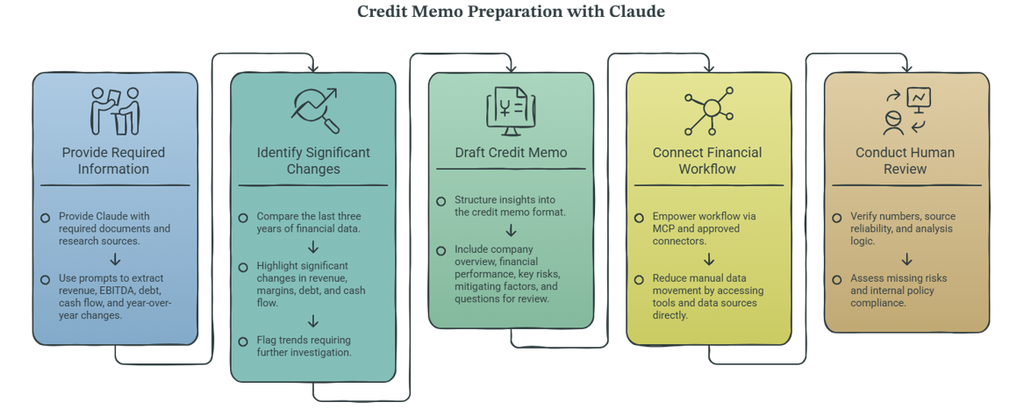
Step 1 | Give Claude the Right Information
The analyst provides Claude with the required documents & research sources.
Via a prompt like
“Review the company’s last three annual financial statements & the latest management report. Extract revenue, EBITDA, debt, cash flow & year-over-year changes.”
Since Claude organizes all the raw information into structured data, the analyst can avoid manually searching each document for the relevant numbers.
Step 2 | Ask Claude to Identify What Changed
Claude can do much more than simple summarization; the analyst has to ask,
“Compare the last three years. Highlight significant changes in revenue, margins, debt & cash flow. Flag any trend that may require further investigation.”
See how the workflow evolved from reading data to finding signals & patterns. This is one of the key AI in financial services use cases to garner data-backed decisions.
Step 3 | Turn Analysis into a Credit Memo
Once the analyst has reviewed the findings in Step 2, Claude can structure the insights into the credit memo format.
Leverage prompts such as
“Using the verified information, prepare a first draft of the credit memo. Include company overview, financial performance, key risks, mitigating factors & questions requiring analyst review.”
This is how Claude AI for financial analysis helps the credit analyst quickly prepare drafts based on her judgment.
Step 4 | Connect Claude to the Financial Workflow
The analyst can further empower her workflow via MCP (Model Context Protocol) and approved connectors. Claude can use the tools & data sources available to the analyst, based on the permissions granted.
So now the workflow will be
Claude → MCP → Approved financial systems/data → Retrieve or process information → Claude analyzes it → Human reviews
Which earlier was
Financial Systems / Documents → Analyst collects information → Uploads/Pastes into Claude → Claude analyzes → Analyst reviews → Analyst updates financial system
In short, MCP can reduce manual data movement and help analysts spend more time on analysis & judgment rather than collecting and transferring information.
Step 5 | Human Review Comes Before the Decision-Making
A finance expert must make the final decision. Because she checks
- Are the numbers correct?
- Are the sources reliable?
- Does the analysis make sense?
- Are important risks missing?
- Does the recommendation meet the company’s internal policy?
Only after this holistic review will the final output be shared as a credit memo. This human-in-the-loop approach ensures that efficiency & compliance can be balanced in high-stakes finance markets.
What Changed for the Financial Team?
The biggest difference you’ll notice is where and how employees spend their time.
| Workflow (without Claude) | Workflow (with Claude for Financial Services) |
| Collect | Provide context |
| Search | Claude analyses |
| Copy | Claude drafts |
| Compare | Human verifies |
| Write | Human decides |
| Review | # |
Financial Workflows | Before vs After (Claude)
Claude handles the information-heavy work, while your employees focus on judgment, decisions & exceptions.
How Wildnet Edge Fits into the Equation?
Deploying Claude for Financial Services is different from empowering your staff with Claude accounts. Because an enterprise can’t simply leverage this model, it needs customization to work in your production environment without flaws.
With Wildnet Edge, a Select Services Partner for Claude, you can add a custom layer around Claude so it works how you want, without overspending, and delivers results on time. That is why finance companies worldwide leverage our AI-powered finance software development services to build custom solutions that keep delivering.
Conclusion
From KYC to credit analysis, Claude for Financial Services can support your business efficiently to deliver better results in less time. It can help your enterprise sort data, review it, identify patterns, and suggest insights accordingly.
But the real opportunity isn’t to delegate all the work to Claude; it’s to leverage it for time-consuming tasks while keeping your human specialists to deliver the final word.
This is how your business can move from the Claude experimentation stage to custom Claude-driven solutions in no time and beat the competition for the foreseeable future.
FAQs
Financial teams should start by defining
– One workflow,
– Approved data sources,
– Measurable acceptance criteria, and
– A responsible reviewer before experimenting with a Claude pilot.
Optimize your AI workflow to flag any gaps & conflicting figures for a human analyst review, instead of silently filling them with assumptions.
Keep,
– Source references,
– Generated outputs,
– Model versions,
– Approval records &
– Reviewer corrections to ensure that Claude-assisted work is easily auditable.
By comparing turnaround time, human review effort, accuracy & total cost vs. the existing processes.
By revalidating affected workflows against corresponding test cases before introducing changes into the production version.

Vidit Kumar is an expert in DevOps and cloud engineering, specializing in building efficient, reliable, and scalable systems for organizations of all sizes. He has deep expertise in automation, cloud infrastructure, and workflow optimization, helping teams streamline operations and improve software delivery processes. Vidit is passionate about mentoring teams and exploring innovative tools that improve software performance and delivery. He believes in blending technical skill with thoughtful problem-solving to create systems that make a real difference. Outside of work, Vidit enjoys experimenting with cloud platforms, learning new technologies, and finding smarter ways to approach engineering challenges.



 based on 1200+ reviews



