


ChatGPT Use Cases for eCommerce: Five Connected Workflows
 By Vidit Kumar
4 Mins read

Key Takeaways
- Start with a task that slows your team down.
- Link AI to the store facts that you can trust.
- Check who can view the data & approve changes.
- To benefit from ChatGPT use cases for eCommerce, track quality, time & cost of work.
eCommerce tasks require real-time collaboration between various divisions. Whether it’s delivery, warehouse, customer support, or vendors, a customer support executive needs them to work together.
ChatGPT use cases for eCommerce can ensure eCommerce tasks are handled effortlessly. They can empower product search, returns, store content & support.
For mid-market store leaders in the UK, Canada & US, the goal is clear. Help a smaller team cater to a large number of customers that they usually cannot while ensuring quality & consistency.
How Does ChatGPT Connect to Your Store?
You need to provide a secure link to store data for ChatGPT to work for eCommerce. This link allows the AI automation to read the right facts, such as checking
- A product’s size, or
- An order status.
Access to customer & company data must be governed. Always start with read-only access and only give change access when necessary. Generative AI in eCommerce can turn these facts into clear drafts. Human staff will be needed to verify and approve them.
Five ChatGPT Use Cases for eCommerce: What Evidence Shows
Each of the 5 use cases shows how ChatGPT or OpenAI’s solutions empower eCommerce businesses worldwide.
01 Help Shoppers Find the Right Product
A shopper might know the look they want. But may not know what words to search for. AI can turn the conversational query into a short list.
Business Benefit:
Zalando used GPT-4o mini to craft a recommendation carousel and improve product clicks by 23% & wishlist additions by 41%.
What to Check:
- Do the picks fit the need?
- Are they in stock?
- Track purchases as a separate variable.
02 Fix Gaps in Product Details
A missing size or a wrong color is enough to confuse shoppers. AI can help check product facts against store rules. Then staff can review claims without clear proof.
Business Benefit:
Wayfair used OpenAI models to check more than 11 million product specifications.
What to Check:
Count errors & corrections. Generative AI in eCommerce needs solid facts to deliver helpful results.
03 Serve Shoppers in More Languages
A shopper should be able to browse and ask for help in their own language. The tool should also understand local terms & context.
Business Benefit:
Zalando expanded its assistant to provide local-language support across 25 markets using GPT-4o mini. This helped them handle 12X more traffic without spending anything extra.
What to Check:
- Test each language with local staff.
- For a Canadian store, align language support with shoppers.
04 Bring Return Records into One Place
A buyer & seller may disagree about a return. Staff need the order facts, messages & shipping records. AI can gather that context to help resolve the case.
Business Benefit:
Mercado Libre used Verdi, its custom GPT-powered platform, to handle 10% of customer-service mediation on one major site within a few months.
What to Check:
Keep a person in charge of high-value or disputed cases.
05 Cut Repeated Supplier Queries
Supplier questions pause the backend work. The team needs to check the listing or internal record to answer these questions. eCommerce workflow automation can help in finding the next step.
Business Benefit:
Wayfair reported automation of 41K supplier support tickets each month.
What to Check:
Track reopened tickets, correct answers & staff time saved.
You can either use these 5 ChatGPT use cases for eCommerce or start automating something new with our ChatGPT development services.
A Delivery Question, From Request to Result
To help you understand how ChatGPT for eCommerce workflows function, here is a relatable scenario. A shopper asks, “Where is my order? Can I change the address?”
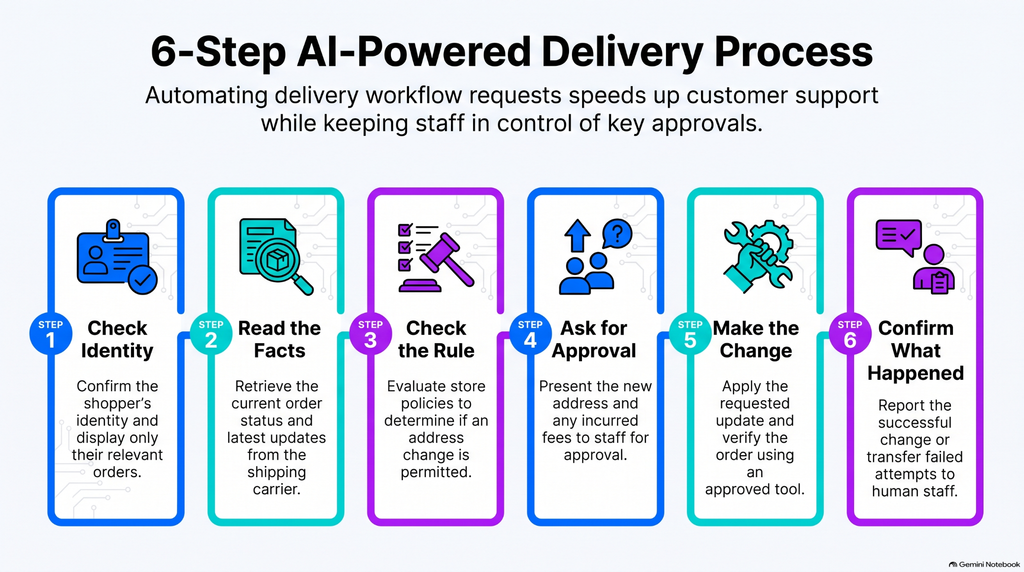
A ChatGPT Use Cases for eCommerce | Delivery Question & Address Change Request
Step 1 | Check Identity
Confirm who the shopper is and show only their orders.
Step 2 | Read the Facts
Get the order status & latest carrier update.
Step 3 | Check the Rule
Is an address change allowed?
Step 4 | Ask for Approval
Show the new address along with the fee incurred. Send it to the staff for approval.
Step 5 | Make the Change
Make the change, then check the order again using an approved tool.
Step 6 | Confirm What Happened
Report the saved change. If any failure occurs, report it to the staff for handover.
For this eCommerce workflow automation pilot, compare results with baseline performance (before the AI workflow was introduced). Track time saved, correct replies & cost per solved query. Test a failed change and repeat request as well.
How Wildnet Edge Helps Your Team Build
Wildnet Edge helps you choose an eCommerce task and plan the build accordingly. Using our ChatGPT development services, you can
- Set the budget, goal, owner & review rules.
- Link the right records via API integrations.
- Test failed actions, wrong data & peak demand.
- Review quality & cost before a wider launch.
With us as your OpenAI implementation partner, you will know how each step serves your goal.
Conclusion
Choose ChatGPT ecommerce use cases based on your team’s needs. A busy support desk may need quicker order checks. A large store catalog might need better product facts. A store selling across multiple markets may need help answering shoppers in their own language.
Pick one task. Name an owner. Set a baseline. And expand the AI pilot once its efficiency is proven. Connect with us at sales@wildnetedge.com whether you are starting from scratch or have a pilot, and we will handle the rest.
FAQs
Which AI use cases in eCommerce should we try first?
Choose the use case that solves a frequent & costly task and involves humans. You will need trusted data & clear rules to see it through.
Are these results guaranteed?
No, each business has its own requirements, operating market, and target audience. So results will differ for each business.
What should be included in ChatGPT development services?
It should include a clear plan, testing, secure data links, support & staff training.
How do we choose an OpenAI implementation partner?
Find out who will own the work, how costs will be tracked & how the OpenAI implementation will be tested.
Can ChatGPT connect to our existing eCommerce tools?
Yes, via approved integrations with your order system, store & support tools. Set clear access rules & human approval scenarios.


